Mostrando las entradas con la etiqueta Emerging Markets. Mostrar todas las entradas

2014/07/31

Are Some Emerging Markets Setting Themselves Up for a Fall?

 In part two of an interview with Simon Johnson, the former IMF chief economist looks at problems brewing in emerging markets, which have “gone crazy borrowing in foreign [currencies].” He also weighs the different approaches bank regulators take in the U.S. versus Europe. “In Europe, they’re still shell shocked from the sovereign debt crisis [and] very scared of doing anything that would destabilize … their recovery. As a result, the bankers are able to dictate the terms to the regulators.” Johnson also expresses skepticism at the idea that national banking regulators will look after each other’s interests during a crisis. 
An edited transcript of the conversation follows:
Knowledge@Wharton: [A recent] Martin Wolfe column in the Financial Times ended with a recommendation [similar to the one] you were making — that Europeans should be upping equity requirements rather than the road they’ve gone down, or in addition to the road that they’ve gone down. 
There’s the state of mind of the regulators, and then there’s whether they actually have the resources to do it, even if they had the will. Where do the resources come from? You said the 60 billion euro is too small … relatively speaking to the problem. How would you evaluate the resources that are being thrown at this issue? 
Johnson: I think the main resource is one of legal authority. And also … the intellectual dimension. Do the regulators have a sufficiently skeptical view of these large complex financial institutions? Do they force them to simplify? Do they require more safety measures, such as larger buffers of equity, which is by far the most important issue right now? How do the regulators see this? Do they have the legal powers to push for the right kind of changes?
In the U.S. they do. In Europe, they’re still acquiring those powers. I think intellectually there’s a split within the U.S. official community. But the people in favor of making the system safer and more resilient have a slight upper hand at the moment. It may change. I may regret saying this, but that’s the current direction — a little bit encouraging.
In Europe, not so much. In Europe, they’re still shell shocked from the sovereign debt crisis, and they are very scared of doing anything that would destabilize, in their view, their recovery. As a result, the bankers are able to dictate the terms to the regulators. So, I don’t think it’s a lack of resources, per se; it’s a lack of intestinal fortitude. But you have to understand that in the broader European context — with the macro economic problems — it’s hard not to be somewhat sympathetic to the regulators. 
Knowledge@Wharton: You have different approaches on different sides of the ocean…. In a real crisis, there are no borders, and there’s contagion and all the rest of it. So … if there’s a problem … how do you resolve this? It may be a U.S. bank, but they have enormous holdings overseas…. I know there have been moves for cooperation across the ocean, but where does that stand? And does this recent European legislation change that state of cooperation or improve it in some way? 
Johnson: The Europeans are trying to get better cooperation for resolution within the euro area, which would be a very important step. 
Knowledge@Wharton: That’s the bank union step? 
“It’s an awful lot to bet on regulators and liquidators treating each other in a pleasant way: British regulators looking out for American interests? Why would they look out for American interests?”
Johnson: Well, it’s part of the banking union. Banking union has many dimensions — agreeing to have a common approach to resolution, a common resolution framework, clear rules for sharing the losses depending on where the activities are and what went wrong in the bank. I think we’ll only believe it when we see it — when we actually see one or more banks go through that.
But they definitely understand that they need to move in that direction. The big issue is the cross border piece between the U.S. and the U.K., the U.S. and the eurozone, the U.S. and other jurisdictions, and of course between all these jurisdictions — between each other. That remains really problematic. There are not binding agreements on how to handle it. 
We have some memos of understanding. And there is some, perhaps, better communication [than] in August and September 2008. But we haven’t stress tested that. We haven’t seen it under pressure. And we haven’t seen what happens when, as you said, a large American bank that has a big operation in the U.K. is in trouble. Do the U.K. authorities move to seize assets because they’re concerned [about the] abilities [of that bank] in the U.K.? [Do] they move to seize those assets in the U.K.? Or are they comfortable with some of those assets coming back to the United States as part of an integrated resolution in the U.S., believing that value will be available to satisfy creditors and other counterparties in the U.K.? That’s a very complicated and delicate matter. And I really don’t think it’s all sorted out. 
Knowledge@Wharton: After the Asian financial crisis in the 1990s, there were a lot of agreements among countries to have cooperation when it came to foreign exchange, because that started out as a foreign exchange panic or crisis. But that wasn’t the problem that came up in 2008. And the next crisis, whenever it might be, we don’t know how it will start. Can you describe what steps have been taken that might help with this cooperative effort that could be effective, between say Europe and the U.S. or other banks in Asia and so forth? 
Johnson: Well, the main steps that have been taken are in the form of these statements of agreement of principle. The Bank of England has said they understand what the FDIC would do in the event of a crisis here. And they appreciate that that could well be the right approach for the bank on a global basis.
From the point of view of what matters in a crisis, it’s all a bit loose. And you’re relying on a lot of good will. There will be, remember, enormous time pressure when these crises develop. Big decisions have to be made in a 24-hour window, if not faster. And it’s an awful lot to bet on regulators and liquidators treating each other in a pleasant way: British regulators looking out for American interests? Why would they look out for the American interests? Or Koreans looking out for American interests? Their job, their responsibility — in some countries it’s a legal responsibility — is to look out for their own citizens, their own exposure and their own taxpayers’ potential losses.
So it’s very hard, unless you have a binding treaty. Unless the countries were actually writing down what they would do, when and how, I don’t think you’re actually ever going to get there. 
Knowledge@Wharton: You make an appearance in a book written by Jeff Connaughton — The Payoff: Why Wall Street Always Wins.
He’s a former lobbyist and Congressional staffer. So he’s got a view of both sides of the street. And he gives a pretty devastating look at the inner workings of Congress and the influence of Wall Street lobbyists, and money and fund raising and so forth. I know that you were working with former Senator Ted Kaufman to try to add some more bite to some of the financial legislation. Some of it made it through, but a lot of it didn’t, at least what he and [Senator] Sherrod Brown wanted to do. It is now probably two years since the book was written. Has much changed since that time in regard to the issues that were discussed in the book? 
Johnson: I think Jeff’s points about the structure — the influence industry around Wall Street — are now just as true as they were then. What has changed is that the crisis woke people up and people began to realize that just allowing the financial sector, including big banks, to do whatever they want, any kind of innovation, any kind of change in their size and structure — this was not necessarily good for economic growth, not necessarily good for the rest of the economy. And the notion of systemic risk, I think, is very much on the minds of many officials.
Sometimes these banks can get big enough and leveraged enough so they cause danger to the financial system. And that can have big negative effects. Even if you avoid a Great Depression you can have a Great Recession, and you can lose more than 8 million jobs and struggle to come back five, six years down the road. 
What’s changed a little bit is there’s no more of a push back against the influence industry. Now they’re very powerful. They have a huge amount of money. They put money into explicit lobbying, but also in many ways they can influence opinion in and around Washington, primarily, and also around the country. 
There are more people concerned about that, more people pushing back and more officials inclined to push back now. So, the outcome of the process of financial reform, I think, remains in question. But I am a little bit more encouraged than somebody might have been just after reading Jeff’s book, for example. I think it’s not over, and it’s not a foregone conclusion that the same dangerous power structures prevail as before. 
“The outcome of the process of financial reform, I think, remains in question. But I am a little bit more encouraged…. It’s not over, and it’s not a foregone conclusion that the same dangerous power structures prevail as before.”
Knowledge@Wharton: What’s your latest project? 
Johnson: I’m interested in the history of bailouts. I think we have a long history of protecting individuals, protecting different kinds of firms in various settings in the United States and in the Western tradition. But we’ve changed over time a lot. The terms of the bailout, what you need to do in order to get it, who we regard as being critical, what justifies a bailout — I think that’s an important story to tell people, preferably in a relatively gripping way, because there’s lots of drama. There are lots of compelling individual characters. 
Knowledge@Wharton: The latest being maybe the U.S. auto companies? 
Johnson:  Yes, absolutely. Auto companies. But also the banks and the financial system going forward. Because sometimes you get the impression when you listen to, I don’t know, a top official at the Federal Reserve, that a certain set of activities will be bailed out because that’s what the science says. And everything else is on its own. In fact, it’s much more of a give and take, and it’s much more about a sequence of events and what particular individual’s in the hot seat at the moment. What did Hank Paulson want to do? Why did he do it? Tim Geithner also is a fascinating character. A lot of decisions made in these periods of turbulence are huge. 
It’s better to have a more open debate and discussion about the nature of bailouts. When does a bailout make sense, and when does it not make sense? It’s better to have that discussion now in a period of relative calm than to try and have it on a Friday night when you know that you have to make a decision one way or the other by Sunday evening before the Tokyo market opens. So that’s what we’re trying to do. 
Knowledge@Wharton: When should there be bailouts, and when shouldn’t there be? 
Johnson:  Well, I think the answer depends on how you define the national interests and the nature of — in economist jargon, externalities. 
Knowledge@Wharton:  So how many jobs are affected? 
Johnson:  Well, the externalities, yes. And what’s interesting about the United States, and a big advantage we have relative to a lot of countries, is we have a relatively efficient commercial bankruptcy procedure. Meaning the bankruptcy process through which firms have to go doesn’t destroy a lot of value. In some countries it does destroy a lot of value. In the United States, the value of the firm may well be heading down before you go to bankruptcy, but the act of actually going through Chapter 11 or some other part of the bankruptcy code — even liquidation — that act doesn’t reduce the value in a discreet way. And you can often come back out of bankruptcy, which is a remarkable American phenomenon, I must say.
So we can do that for some firms. Now we didn’t do it for the auto firms. That’s very interesting and important. We didn’t do it for the airlines after 9/11, by the way, because of what were regarded to be important overriding interests there. They got some additional support. And we didn’t do it for the big banks in 2008/2009.
Now I think it’s a fair question: Would you do it again for General Motors? If not, why not? Would you do it again for J P Morgan Chase? If not, why not? I think those are very interesting and important questions to debate now and to have a much broader understanding. Don’t let the technical experts decide it in a dark room. 
Knowledge@Wharton: What else happening on the world stage in finance would be important to think about? 
Johnson: I think emerging markets are lining themselves up for more problems. The official sector has been relatively restrained in terms of borrowing through the latest cycle. But the up-and-coming globalized multinationals from some of these countries have gone crazy borrowing in foreign exchange.
“The terms of the bailout, what you need to do in order to get it, who we regard as being critical, what justifies a bailout — I think that’s an important story to tell people.…”
If you remember back to what we might consider to be the first modern emerging market crisis, which was Chile at the end of the 1970s — 1982 is when it really got bad — most of the debt taken on in Chile in foreign currency in dollars was by the private sector, not by the government. It became a public sector responsibility. There was a form of bailout, if you like, a very messy form.
But it was private borrowing. And I think that there are some people in emerging markets — India would be one country that springs to mind – [who] have forgotten that. They think that as long as the public sector remains relatively restrained and we don’t have a lot of foreign-currency-denominated debt on our balance sheet in the government sector, we’re OK. But foreign-currency-denominated debt held by the private sector or issued by the private sector can also be very damaging. 
That’s what happened in the Asian crisis 1997-1998. In Indonesia, Thailand, Korea, the main problem was that the corporates had borrowed either overseas or in mostly in dollars, not that the government had. But then it becomes a government responsibility, and the government has to take steps to try and stabilize the macro economy when that debt turns against you. 
Knowledge@Wharton: So the same is true for Ireland and Spain, is it not, for the recent financial crisis — mostly private debt taken over by the government. 
Johnson: Yes, but the important difference maybe is that it’s in euros, right? So it is their currency — it’s not a currency controlled by the Central Bank of Ireland, Central Bank of Spain, it’s controlled by the Central Bank of Frankfurt.
And you might also argue it’s actually more difficult to get out of the Irish/Spanish/Greek version of this debt crisis because your currency doesn’t depreciate. You can’t become more competitive relative to countries with which you’re competing. You’re stuck at this same exchange rage. Wages and prices can change, but that’s a relatively painful adjustment process. But you’re absolutely right: It was private borrowing in Ireland and Spain. And that makes them different from Greece. 
Knowledge@Wharton: In Asia, then, because they had their own currency, as painful as it was and as big as the drops were, they bounced back relatively quickly compared to what’s happened to places like Spain and Ireland, which are still struggling with very high unemployment. 
Johnson: That’s exactly right. Now they have a different structure of the economy. They were much more export-oriented in Thailand and Indonesia and Korea, for example. But the recovery was absolutely without question faster than what we’ve seen in most of Europe. And it was in part because of the depreciation of the currency. Iceland would be another case. Very traumatic. Nothing nice about the Icelandic crisis. But the depreciation of the currency has played a role in facilitating a better recovery than what otherwise might had been the case. 
Knowledge@Wharton:  They took over their banks too, didn’t they — the government [in Iceland]? 
Johnson: There was no alternative. The banks defaulted first. And then the defaulted banks were taken over. So the debt, which was at least 11 times GDP, was written down massively. The government went from being a low debt government to a relatively high debt government. But the debt burden is manageable because they wrote it down before the government takeover. 

2013/09/02

The Meltdown Of The 4 Worst Emerging Market Currencies In 2 Charts

For those of you who are a bit behind, emerging market stocks, bonds, and currencies have been getting slammed this year.
"The proximate cause of all these bloodbaths in emerging markets is the declaration by Fed Chairman Bernanke in mid-May that the Federal Reserve would begin to “taper” its purchases of securities should the U.S. economy continue to recover," said Wells Fargo Chief Economist John Silvia.
But you can't just blame the Fed for the emerging markets' woes.
Silvia what's happening with the four worst emerging market currencies in his latest Weekly Economic & Financial Commentary:
em currencies
Wells Fargo
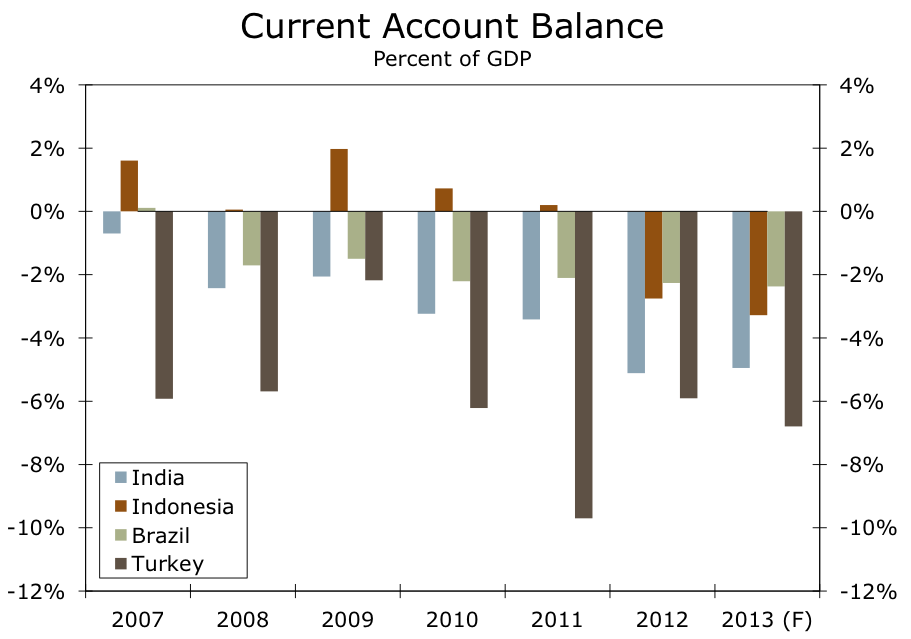
This foreign selling of emerging market assets has caused the currencies of many developing economies to depreciate vis-à-vis the U.S. dollar (top chart). Among large developing economies,  the worst performing currencies over the past three months have been the Turkish lira, which has weakened about 10 percent against the greenback, the Indonesian rupiah and the Brazilian real (both down about 15 percent or so). The Indian rupee has plunged 20 percent, and it nosedived to an all-time low against the dollar this week. What distinguishes these currencies from, say, the Taiwanese dollar, which is only a bit weaker versus the U.S. dollar relative to early May?
em current account
Wells Fargo
What these countries have in common is that they each run current account deficits at present . In some cases, the rise this week in oil prices, due to the escalation of the Syrian crisis, has added to the selling pressure on some emerging market currencies. India and Turkey import most of their crude oil needs, so higher oil prices automatically lead to wider current account deficits. Current account deficits need to be financed from capital inflows from abroad, but when foreign investors head for the exits the currencies depreciate. This depreciation makes exports less expensive to foreigners and imports more expensive to domestic residents. Over time, currency depreciation should cause current account deficits to narrow again.
So, eventually, this should work itself out. But in the near-term, it looks like the pain will continue.


Read more: http://www.businessinsider.com/emerging-market-currencies-2013-9#ixzz2dkPqfoda

2013/07/17

Emerging Market Multinationals: New Giants on the Block

Article ImageIt has for some time been a truism that if you want to see the division of world power, you need to look beyond the map of nation-states. A slew of multinational corporations have annual gross incomes that exceed the GNP of entire nations. Moreover, though they don't have a seat at the United Nations, these corporations arguably wield much greater power than many nations on the world stage.
The familiar story of the rise of multinational corporations focuses on the usual suspects: longstanding powerhouses, mostly based in the United States and Western Europe, like Walmart, IBM, General Electric, Exxon, BP and Volkswagen. Japan's massive post-WWII investment in modernization allowed it to become a leader in the automobile and electronics industries.

In the last twenty years, that story--and the multinational map of corporate power, as it were--has undergone a fundamental shift: away from established companies in the developed world and toward ambitious upstarts in the developing world. In their book Emerging Markets Rule: Growth Strategies of the New Global Giants, Wharton management professor Mauro Guillén and co-author Esteban García-Canal shine needed light on this new twist in the story, one that has been largely underreported in the mainstream press.

When Forbes first published its Global 2000 list in 2003, the United States, Japan and the United Kingdom dominated. By 2012, emerging markets had broken that stronghold in a big way, in many cases leapfrogging established players like AT&T, Gulfstream and Sara Lee. Emerging market multinationals (EMMs) are now at the top of markets as varied as household appliances, ready-mix concrete, seamless tubes for oil drilling, regional jets, meat, bread and candy. Yet recognition of this trend has been spotty at best. In 2010, for example, the Chinese battery and electric automaker BYD topped Bloomberg Businessweek's Tech 100 list. Warren Buffett was so impressed he took a 10% stake in the company. Yet a March 2012 search of the previous year turned up only one mention in the New York Times, while the 98th-ranked firm, California-based VMWare, showed 1,100 results for the same period.

The EMM Revolution
What exactly is an "emerging market"? A 2010 article in Forbes by Tarun Khanna and Krishna Palepu of Harvard Business School (authors of the book Winning in Emerging Markets) summarizes the history and essential features of emerging markets. The term was first coined in 1981 by economists at the International Finance Corporation. In sum, it denotes countries and markets playing catch-up: nations with an undeveloped industrial base and infrastructure on the one hand, but a rapid rate of growth (usually exceeding that of developed nations) on the other hand. In addition, emerging markets are often distinguished by some level of political and institutional instability, and ongoing demographic growth.

Definitions aside, the dramatic surge of EMMs certainly represents a sizable geopolitical shift. Yet just as significant as the fact of companies in developing countries asserting global dominance are the methods by which they have done so. This is a revolution not just in whobut in how. EMMs have made their mark by moving boldly, swiftly, strategically and often stealthily; by nimbly negotiating the often volatile political and economic landscapes of other emerging markets; and by treating joint ventures and other initial forays into acquisition and expansion as learning experiences. This approach, the authors contend, stands in stark contrast to the more plodding, rigid, top-down methods traditionally employed by entrenched multinationals.

Guillén and García-Canal suggest a number of reasons why EMMs as a group seem to exhibit a different approach, and an entirely different institutional culture. Most of these companies, and their owners, cut their teeth in environments characterized by political and institutional instability, and a range of limitations in infrastructure, technology and capital. Early on, they learned to make more out of less and to be comfortable with risk, volatility and uncertainty. As well, many are either family- or government-owned, are free from the second-guessing of stockholders, and thus able to keep their eyes on the long-term prize, even if their strategy results in some short-term bumps in the road.

Strategizing on the Go
Based on their 20-year study of EMMs, Guillén and García-Canal have distilled seven "axioms" that for them define the 21st century way of global business. None is more important than the first: "Execute, Strategize, Then Execute Again." These simple words imply two of the book's central themes: that execution is of primary importance and that the best strategy emerges organically from practical experience on the ground.

Among old-guard companies, the authors argue, strategizing has become both a ritual and a crutch. Not only do managers "agonize" over formulating the perfect strategy; once they think they've found it, they become infatuated with it, clinging to it even in the face of rapidly changing circumstances. They cite Benetton and Matsushita as "examples of companies with strategizing run amok." Benetton, a trendy Italian clothing designer, launched a number of high-profile, edgy campaigns in an effort to crack the American market -- all incomplete successes at best. The Japanese electronics firm Matsushita (now known as Panasonic) developed a once highly touted 250-year strategic plan -- but then lost ground in the marketplace due to insufficient attention to detail.

By contrast, the Mexican company Bimbo challenged and eventually overtook established power Sara Lee in the bread business through relentless attention to operational detail. Faced with an uphill battle, the Mexican upstart knew its only chance was to win the battle of execution. Because bread is a commodity in which freshness and timing are of the essence, Bimbo computerized its distribution network in a way Sara Lee never had. On the other hand, in expanding to China, the company deployed tricycles in order to make timely deliveries to older parts of town with streets too narrow to accommodate trucks. Bimbo executives aggressively embraced a trial-and-error approach in their expansion to China and other markets -- a process, in the words of one manager, "full of learning, unlearning, experiences, challenges and failures." Guillén and García-Canal call this "strategy wrapped around implementation.... You execute to figure out what strategy works, and then you pursue it relentlessly by focusing on execution itself."

The Trojan Horse of Niche Markets
Harkening to the guerilla tactics first set out in Sun Tzu's The Art of War, Guillén and García-Canal view highly targeted niche markets as a kind of stealth weapon allowing emerging market upstarts to gain a toehold in the competitive and often more saturated markets of developed countries. Established companies, they say, often neglect or fail to adequately serve these narrow markets. Having dismissed such markets as of marginal importance, they are not alarmed when a hungry overseas competitor sets up shop in their own backyard by entering an underserved niche. "They see an annoying gnat, not a Trojan Horse using the path of least resistance to take over the stronghold of an established brand."

The Chinese appliance manufacturer Haier, for example, cracked the American market by catering to the niche market of college students looking for compact refrigerators. They then moved on to wine coolers and other highly specific lines. As recently as 2006, the head of Whirlpool's North American Region didn't see Haier as having "any perceivable position" on its home continent. Today, Haier sells its entire product range in the United States, has a major manufacturing facility in South Carolina and is the world's largest household appliances brand.

Like Haier, other EMMs have used niche markets as stepping-stones to a mainstream mass market. New technology, the authors point out, makes serving niche markets more feasible than before: Flexible production systems allow companies to produce small batches and still make a profit. Moreover, even though a narrow market in just one country may be marginally profitable at best, the numbers turn favorable when serving that same niche across many national markets. The Mexican brewer Modelo, for example, broke into the U.S. market through Corona Extra, its entry into the very specific niche of light import beer -- a market segment over which Heineken held a virtual monopoly. Initially targeting college students and Mexican immigrants, Modelo quickly boosted sales from 1.8 million cases in 1984 to 13.5 million in 1986. The company then went global with this strategy, and Corona Extra is now the number-one import beer in China, India, Japan, Australia and the United States, among others. In 2008, the company purchased Anheuser-Busch, and today Mexico has surpassed both the Netherlands and Germany to become the world's top beer exporter.

'Never Say No to the Market'
To some extent, old-line multinationals were accustomed to simply imposing their will on the market. The authors cite IBM as a prime example of a company "accustomed to imposing its vision, strategy and products on buyers." The approach of the new EMMs has been different. They allow the market -- and not just the market in a macro, impersonal sense, but in the form of the wildly variable and often unpredictable needs and desires of individual customers -- to dictate strategy.

The enthusiastic embrace of niche markets is only one way EMMs have learned to follow the market. Haier is again a model of this philosophy, taking the above motto of its CEO to heart in one of the book's most telling anecdotes. Back in the 1990s, when the company was still focused exclusively on the domestic market in China, Haier's service division ran into a recurring problem: Its washing machines were breaking down because customers were using them not only to wash clothes, but also to rinse potatoes and vegetables. Instead of trying to "educate" its customers about the "proper" use of the machine, Haier identified a need and responded to it -- designing a specific, dual-use model for that customer base.

Suzlon of India listened to the market in a different way. Founded as a textile company, the company grew tired of the erratic and inefficient service provided by India's state-owned electricity network. It began looking into developing its own wind-power generators and, with no background or expertise in the field, had to learn the technology from scratch. Recognizing the huge potential in the market for alternative energy, it sold off its textile business in 2001 and is now exclusively devoted to the development of wind farms. Suzlon has risen to the top of the market in India, is number two in the United Kingdom and third in France and Germany.

Speed and Scale
Upstart EMMs have managed to leapfrog entrenched companies, not through cautious and incremental growth, but by thinking big and acting boldly. A number of them have spent years and even decades consolidating their position in their home countries. But when they made the move to go global they have done so at near lightning speed, and with a varied attack utilizing vertical integration, joint ventures, rapid expansion and strategic acquisitions. By contrast, "even after entering foreign markets, old-line multinationals tended to escalate their commitment of resources slowly."

Samsung Electronics of South Korea exemplifies a bold and swift commitment to scale. Founded in 1969 as a subsidiary of the larger Samsung Group, its early years were devoted to manufacturing contracts outsourced by American brands. In the mid-1970s, Samsung moved aggressively into the semiconductor business, thereafter focusing on its own brands and proprietary technologies. In each market it has entered, it has scaled rapidly. The company started making batteries for digital devices in 2000; ten years later it was the global leader. 

In 2002, Samsung invested in the manufacture of the flash-memory chips that drive iPhones and iPads; in less than five years, it was Apple's top supplier. By the end of the decade, the company's revenues had surpassed those of rivals Panasonic and Sony. A top executive describes the key to Samsung's success as "aggressive investments and faster decisions."

In telecommunications, Mexico's América Móvil also grew boldly and swiftly, employing acquisitions as a key part of its expansion strategy. Its founder, Carlos Slim, had been a businessman in Mexico since the mid-1960s. His company, Grupo Carso Holding, took a big leap in 1982 when it purchased several Mexican subsidiaries of U.S. multinationals at low prices, generating cash flow that allowed Slim to move into telecommunications in 1990 when the government privatized its national telecom monopoly, Telmex. Now, Slim put his foot on the gas. He focused on the hugely untapped domestic mobile phone market, spinning the wireless business off as a separate entity, América Móvil. 

In 2000, he expanded his company's presence to the entire region by buying up the Latin American assets of a number of multinationals, including American giants AT&T and Verizon. Later, he took advantage of the crisis in the euro and grabbed a controlling stake in telecom companies in Holland and Austria. In March 2012,Forbes declared Slim the world's richest man, with an estimated net worth of $69 billion.

Risk and Resistance
Whether through acquisition or other means, EMMs have often been able to expand swiftly in other emerging markets because of their greater comfort with high levels of risk and volatility. Orascom, a telecommunications company based in Egypt, learned early on how to negotiate the tricky politics of its home nation, and was later able to transfer those skills to emerging markets that established multinationals tended to shun. Since 2000, the company has ventured into a range of global hotspots including Jordan, Pakistan, Zimbabwe, Algeria, Iraq, Namibia and Lebanon. Moreover, the company recognized that the lack of a developed telecommunications infrastructure in these countries was in many ways an asset: Because fixed lines weren't an established fact in many areas, demand for mobiles caught on more quickly than in the developed world.

While upstart EMMs happily embrace risk, they are also savvy enough to make a play for the global market via a product line they can master quickly: another example of choosing the path of least resistance. China's BYD, for example, established a global presence through the market for computer and cell-phone batteries. In 2003, the company bought a controlling stake in a derelict state-owned automaker and applied its expertise in batteries to researching an efficient and economical electric car. By the end of the decade, their auto division was the sixth largest in the rapidly growing Chinese market, and Warren Buffett, after buying a 10% stake in the company, stated that BYD had an excellent chance to eventually become the world's largest automaker. Its chairman recognized the opportunity inherent in the relative simplicity of electric cars, which comprise only 210 primary parts as compared to 1400 for a gas-powered car. "It's almost hopeless for a latecomer like us to compete with GM and other established automakers with a century of experience in gasoline engines," he noted. "With electric vehicles, we're all at the same starting line."

Learning from EMMs
The book's final chapter is devoted to summarizing the methods by which so many Emerging Market Multinationals have challenged more entrenched firms for global dominance and to discussing how companies seeking to enter world markets might learn from their example. They list the big lessons: "executing before strategizing, catering to the niches, scaling to win, embracing chaos, acquiring smart, and expanding with abandon."

More than a set of techniques or strategies, the EMM way of doing business is an entirely different way of looking at the world. Where some view globalization as producing a standardization of tastes, EMMs see a proliferation of niche markets. Where old-line firms view acquisitions as trophies, EMMs see them as opportunities for learning and cross-fertilization. As Guillén and García-Canal sum it up: "What began as a necessity -- a kind of guerilla-business warfare against the corporate superpowers -- has now evolved into best practices and is on its way to becoming what everyone needs to know."

2013/07/12

Fast-growing Middle Classes in Emerging Markets Lure Private Equity

Article Image"Emerging markets" is a catch-all term that tends to suggest outsized risks and the potential for outsized investment returns. But for private equity (PE) firms, this broad term masks the wide-ranging differences between distinctive markets. Large emerging countries like China and India are very different from smaller ones like Bolivia and Paraguay.

So how do PE firms that specialize in emerging markets find opportunities that justify the risks? It's not an exact science, according to speakers who participated in a panel discussion on emerging markets at the 2013 Wharton Private Equity & Venture Capital Conference, but the most appealing markets do share some characteristics, like a growing middle class and business-friendly government.

Some countries, such as Brazil, Russia, China and India (which are also known as the BRICs), are obviously further along in the process of emerging than others, and have a track record of profitable PE investments as an indicator of their market's potential, said Ralph Keitel, principal investment officer of the International Finance Corp. (IFC), the private sector arm of the World Bank Group that invests in PE funds. The IFC invests $12 billion to $15 billion a year, and has a dual goal of earning investment returns and aiding economic development in emerging markets.

Understanding a country's pros and cons takes a "granular" examination, he added, because a single country may be relatively well developed in some geographical regions, "whereas 500 miles to the north or south, people are living in abject poverty." China is a prime example, he pointed out, with vast differences between the developed coastal cities and the poor rural inland areas. It would be a mistake to assume that all of China presents great PE opportunities.

Emerging markets that appeal to PE firms do tend to share some other features as well, said Enrique Bascur, managing partner of Citigroup Venture Capital International (CVCI). "The one thing that they have in common is a higher than average growth rate," he noted. But a high growth rate is not enough if the country's economy is small, he added. That is why countries like Brazil, Mexico, Chile, Peru and Columbia are attractive, but Bolivia and Paraguay are not.

Health Care Opportunities in Emerging Markets
Stephen M. Sammut, a Wharton lecturer and partner at Burrill & Company, a venture capital firm focused on the life sciences and health care, said his firm looks for markets that offer "growth and consolidation of the middle class." They also look for markets where "it is clear that the government policies are moving toward seeing health as a human right." A good market has a culture that encourages innovation and offers a favorable legal environment that provides basics such as contract enforcement, he noted.

Burrill also looks for countries that already have an established foundation in health care, he said. For example, India has a thriving generic medication industry eager to do research, and the government has made it easier for medical research firms to conduct drug trials, Sammut noted.

Keitel said the IFC prefers to invest in a business that, instead of doing what its competitors are doing, can move to the next level. Some markets, for instance, have companies that provide raw materials for medications, and the IFC tries to help them develop the expertise to produce finished products. A firm in one country might produce a drug, while a firm in another makes the syringe needed to administer it. "That would be an example of how we see various parts of East Asia work together," he said.

Different Markets, Different Strategies
The key to PE success in emerging markets is the ability to adapt, according to Keitel. Investors must be able to adapt to wide variations that distinguish one market from another. "Cookie-cutting in emerging markets is not a good strategy," he said. "We believe all business is local. We want to back [general partners] who have a very deep understanding of the market, who understand the culture, who have networks there."
For example, it takes very different strategies to invest successfully in Central America, where the capital markets are undeveloped, compared to South Africa, which has well-established capital markets and a fairly well-developed PE industry, said Keitel.

Business cultures also differ from one region to another, he added. In China and India, the PE firm often takes a minority stake because, for the target company's founder, "retaining control is a very important issue." It's more common for PE firms to take a controlling stake when they operate in Latin America, he noted.

On-the-Ground Presence is Optional
While it is important to have a deep understanding of local markets, this doesn't necessarily mean a PE firm must set up an office in every country in which it operates, said Bascur. "You can have an office there and not be local ... or be outside and understand it perfectly well," he explained. CVCI prefers to set up hub offices that serve multiple countries, he noted. These offices have the size, or "critical mass," that allows them to work more effectively compared to a multitude of small offices with skimpy resources. Typically, the hub is staffed by people from the various countries it serves, added Bascur.

While a country at the early stages of emerging might seem like virgin territory that is ripe with opportunity, it can be useful to have company in the PE space, Sammut observed, noting that indigenous PE funds are now forming in some emerging markets. "In my view, that's been a very positive trend," he said.

Much is often made of the risks of investing in emerging markets. There can be unstable currencies and governments, shaky legal systems, corruption and even warfare. But a closer look often reveals a difference between "perceived risk and real risk," Keitel said. Revolutions in Cairo and Tunis made headlines around the world, but had little effect on PE firms' operations in those cities, he pointed out.

A PE Home Run
The panel's moderator, Timothy J. Hartnett, leader of the U.S. private equity sector at PwC, an auditing and consulting firm, asked for examples of home runs in emerging markets.

Bascur provided one stand-out example: in the early 2000s, CVCI was approached by investment bankers seeking a buyer for a family-owned salt mine in Chile. In the wake of the Internet boom, this seemed like an out-of-the-ordinary opportunity that was about as low-tech as a business can get.

"This salt mine happened to be in the most economical place in the world to produce pure salt," he recalled. The salt lay on the surface only about 10 miles from the ocean, in a place where it almost never rains. Because this salt was so cheap to produce, CVCI saw a chance to capture a large share of the U.S. market for road salt for municipalities, airports and other big users.

The salt mine was purchased for $100 million, and CVCI then bought a Brazilian distribution company to help get the salt to market. After a few years, the operation had captured about 50% of the U.S. road salt market, and the firm was sold for $500 million.

This case was a classic example of an emerging market PE strategy that brought together firms in different emerging markets to serve customers in developed ones, he said.