All three major U.S. stock indices finished trading Friday in the red with the Dow Jones Industrial Average and the S&P 500 giving up gains for 2015. That Nasdaq Composite is still 100 points above the level where it started the year but far off the 5,000 plus mark it finally broke last week.
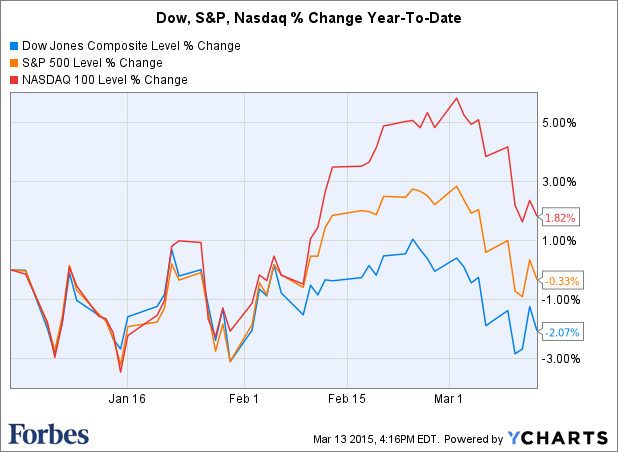
The Dow closed at 17,749 points Friday, down 0.8% for the week; the S&P was at 2,053, down 0.9%; and the Nasdaq at 4,872, down 1%.
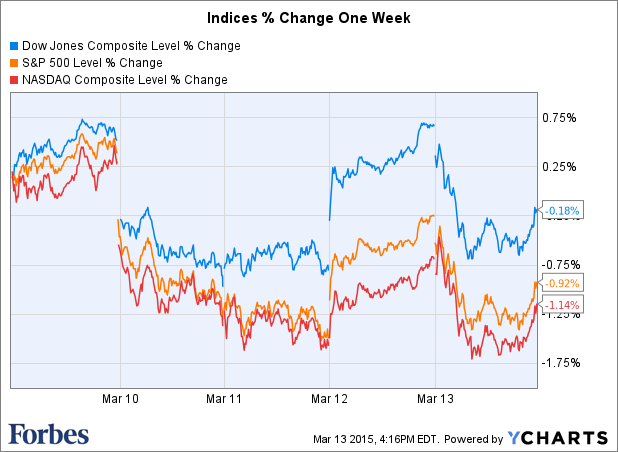
It was an ugly but unsurprising end to a tumultuous week, three days of which stocks ended lower. The sell off has been in response to continued oil sector weakness, further signs that the strong dollar is cutting into big company earnings and concerns that the Fed is is running out of reasons to keep interest rates low.
 Samantha Sharf
Forbes Staff
Friday stocks opened in the red but the decisive blow came around 10 a.m. when the University of Michigan announced a 4.2 point decline in the Michigan confidence index to 91.2, the lowest level in four months. Richard Curtain, the chief economist for the survey, noted in commentary that optimism slipped among low to middle income households and grew among the top third of income households. “The renewed concerns expressed by lower and middle income households mainly involved income declines and higher utility costs as well as disruptions to shopping and businesses due to the harsh winter,” wrote Curtin. “Among those with incomes in the top third, strong gains were concentrated in the near term outlook for the economy and buying plans.”
Economists, including those at the Federal Reserve, have held that lower oil prices will ultimately boost consumer spending and the economy at large but so far that hasn’t shown up in the data. Nevertheless some investors are writing off the data related swings as noise.
“The Fed will be more inclined to raise rates as long as economic indicators, in aggregate, continue to paint a picture of an economy still solidly growing,” wrote Jim Baird, chief investment officer for Plante Moran Financial Advisors in a note on the Michigan release. “The latest strong jobs report and increasing conviction in a likely rate hike in the coming months have contributed to recent volatility in the equity markets. While strong economic news should be viewed as a positive, uncertainty around the outlook for monetary policy and the impact on interest rate will be a continuing source of volatility.” The VIX volatility index jumped 2% over the course of the week and around 3.5% Friday.
The wild ride really started a week ago. On Monday, March 2 the indices reached new highs: 2,117 for the S&P, 18,288 for the Dow and 5,008 for the Nasdaq. In the days that followed the indices gave back some of those gains — it is common for new highs to meet resistance. Things really got ugly last Friday when good news for the economy meant bad news for stocks. That day the Bureau of Labor Statistics released the February jobs report which showed the unemployment rate had dipped to 5.5%, its lowest level since May 2008. This stoked investor fears that Federal Reserve will begin hiking rates in June or September.
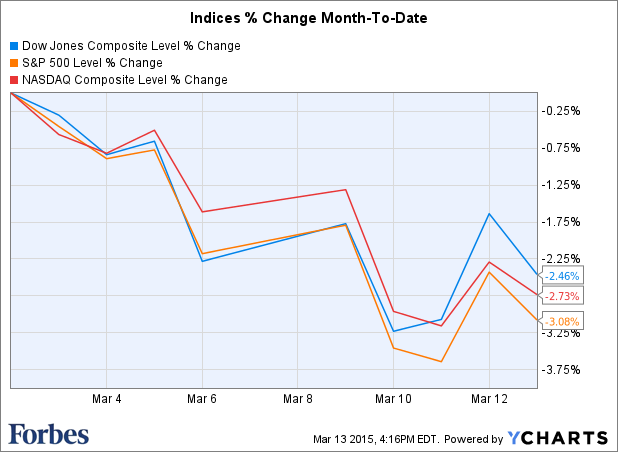
“Last week proved to be a banner week for market milestones,” said Randy Frederick, Managing Director of Trading and Derivatives at the Schwab Center for Financial Research, in a note on the market at the start of this week. “The SPX reached an all-time high, the Nasdaq cracked 5,000 for the first time in 15 years, unemployment dropped to a seven-year low, the dollar hit a 12-year high against the euro, and interest rates reached their highest point of 2015—so that leaves us wondering what this week could possibly have left in store.”


No hay comentarios.:
Publicar un comentario