Mostrando las entradas con la etiqueta management. Mostrar todas las entradas

2018/09/09

How to Run a Public Institution Like a Private Firm

office work project meeting
It goes without saying that managing huge projects is a complex and demanding process that requires continuous scrutiny. Doing so at a brand new public organization on an extremely tight deadline, with a small staff, is even more so, writes Kalin Anev Janse (@kaanev), secretary general and also a member of the management board of the European Stability Mechanism (ESM), the Eurozone’s lender of last resort. His co-author is David Blazquez Vila, team leader for the group’s project management office. In this opinion piece, they describe how they adopted the latest thinking at business schools — and at the Boston Consulting Group (BCG) — to successfully implement their plans. (This article reflects their personal views.)
The ESM, the Eurozone’s lender of last resort, is a mega project in itself. It started with predecessor European Financial Stability Facility (EFSF), which had to be set up in record time at the peak of the euro debt crisis. This 440 billion euro ($514 billion) sovereign backstop was created in less than eight weeks’ time. Only 30 weeks into its existence, the EFSF tapped the market for 5 billion euros, gathering a record-breaking book of 44.5 billion euros from more than 500 investors globally. To date, this is still the largest-ever order book for a first-time issuer. Not bad for a company that was just seven months old. Most start-ups would struggle to match those numbers. We mentioned this in a previous Knowledge@Wharton opinion piece. But we have not yet disclosed how an institution of fewer than 200 people can run such mega projects — business school style.
Seek Inspiration
Caught up in the initial rush, our first 12 employees ran the EFSF in a fast, flexible and entrepreneurial way. We had no time to think through all the details of the structure we wanted for the business. Just as it was up and running, we were tested again. In 2012, we had to open an even bigger shop, with a lending capacity of 500 billion euros and an investment firepower of 80 billion euros.
This time, we wanted to do it differently. We had to organize ourselves better. We were inspired by what business schools were thinking, and by a very interesting report titled, Strategic Initiative Management: The PMO Imperative,” from BCG. We decided to give it a shot and create a real strategic project management office (PMO). The main objective was to optimize our resources to run mega projects with minimal staff using as little taxpayer money as possible. In 2013, this had not yet been seen in the public sector. Only the best private-sector firms applied it. But we were convinced that this new approach would help us create the 21st century public-sector institution that we wanted to work for.
Building mega projects in the public sector
Build a Superb Infrastructure
Last year, the ESM set up a derivatives program for Greece worth more than 50 billion euros. We also issued our first-ever dollar-denominated bond. In total we ran numerous projects, using 7,000 person-days. How did we do that with fewer than 200 people? By first putting a state-of-the-art project infrastructure in place.
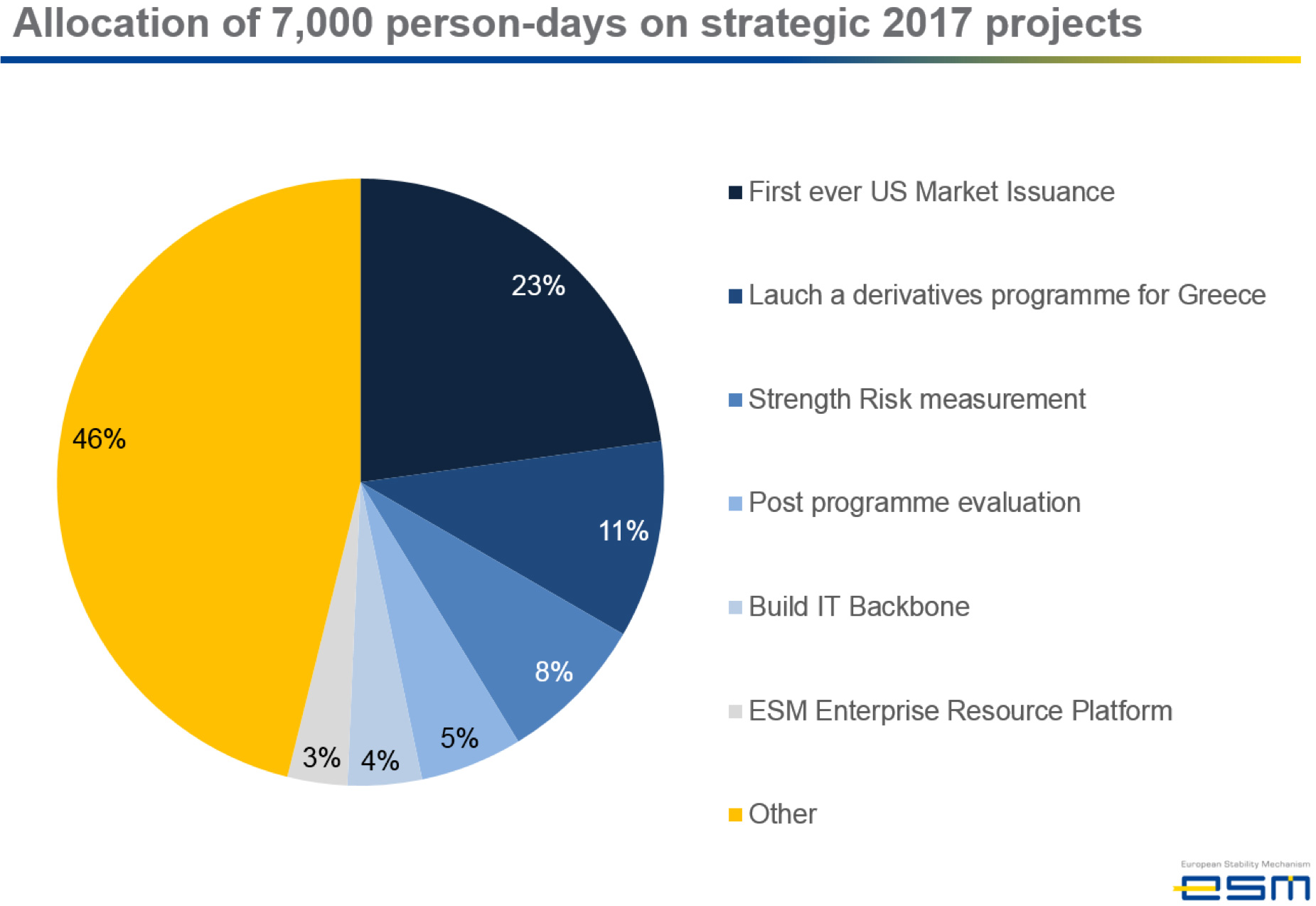
Allocation of 7,000 person-days on strategic 2017 projects
The ESM is an ambitious institution, able to run many new initiatives in parallel. So it is critical to maximize the use of our scarce resources and make sure every staff member remains focused on what is most important at any time.
Our Strategic PMO is run exactly the same way as at a private-sector and profit-driven company. A combination of project portfolio and dynamic resource allocation services support fast delivery, yet allow changes of direction as needed. In an institution whose tasks depend on political decisions, such changes happen a lot.
Last year, we had to put in place the short-term debt relief measures for Greece. This meant exchanging billions worth of bonds from floating to fixed rates, and building a derivative book of 50 billion euros. Typically, such initiatives take 18-to-24 months. We did it in six-to-nine months. A spot-on strategic PMO can dynamically change resources to align them to moving strategic objectives in volatile market conditions.
A Central PMO – at the Heart of the Business
At the ESM, we run all the major and strategic institutional initiatives through our PMO. The PMO is a centralized function, servicing all departments. The PMO provides real-time operational insight, so management has an up-to-date overview of how well we are meeting milestones and objectives. We know exactly where each of the projects stands in terms of resources, budget consumption, deadlines and delivery targets. This way, we can speed up the initiatives that are needed in a financial crisis, or during an assistance program, while relegating others to the backseat and slowing them down. At all times, it allows staff members to maintain focus on ESM priorities.
Our success has five pillars:
  • A flexible project portfolio management service — that can shift gears and priorities at any time — allowing us to deliver on the strategic demands of our shareholders, the 19 countries of the euro area.
  • Not delivering is not an option. The PMO ensures each single project will be completed, closed and evaluated. Without exception. We use experts, project managers, and twist-and-turn project management methodology (e.g., Agile software development) tailored to the public sector.
  • A dynamic resource management system with institution-wide monitoring of projects to identify and solve potential resource clashes.
  • Top Management engagement to ensure buy-in, quick change management, and financial budget approval. A corporate project committee meets and reports monthly to the managing director. The committee is chaired by the secretary general and a member of the management board.
  • These fast decisions require accountability and transparency. Budget performance is evaluated. Over the past years, the PMO has never exceeded its budget, and independent external auditors have signed off on all our work.
A Truly Strategic PMO – More Than Just IT
PMOs only deal with IT issues in pretty much all public-sector institutions we have come across. With such a limited scope, the project manager feels responsible only for isolated IT tasks. But in the majority of projects, IT is not the only critical component for success. At the ESM, we also take into account public procurement, compliance with new regulations, new business processes innovation, and continuous change management. All this should be the responsibility of the PMO and the project manager.
“These days, strategy is tech and tech is strategy.”
Older institutions, with established structures, often face difficulties to overcome the separation between IT and business lines, and between back-office providers and customers. In the 21st century, they should be one team. These days, strategy is tech and tech is strategy.
At the ESM, we built the PMO from scratch, without legacies, establishing a new project management culture. Only 15% of our projects are pure IT projects. With this culture of innovation we transformed the outdated IT-back-office project management model into a modern, strategic, institution-wide business-oriented project management architecture. All human resources participating in the project report to one project manager as far as their project responsibilities are concerned.
Culture Matters
The strategic PMO is now well-established at the ESM and is seen as the most efficient way to deliver strategic objectives. These objectives are set by our shareholders – the 19 countries of the euro area – so we cannot afford any inefficiencies or failures to deliver.
Since establishing the PMO in 2014, the number of projects the PMO supervises has doubled each year. More and more business units are asking that their initiatives be executed under the project management framework. This year, for instance, we ran the production of our annual report as a project for the first time. The number of employees participating in projects has increased to 138 from 76 on a full- or part-time basis – 80% of staff.
Stronger Together
The public sector is increasingly recognizing the project management function as the best tool to deliver strategic initiatives using the least taxpayers’ money. The European Commission has launched a project management initiative called PM2, aiming to establish a common European signature project method. We have joined this initiative.
Business School Takeaways
Introducing a private-sector best practice to the public sector proved to be the right choice four years ago – even though it was pretty innovative. Our approach was to learn different methodologies (like PMI and SCRUM Agile) and frameworks (like lean and change management) and offer a toolkit to select the most effective formula for each project. Our key business school and business practitioner takeaways are as follows:
  • An institution-wide, strategic PMO is the most effective mechanism for the C-level to drive the direction of the organization, and align resources with strategic objectives. The PMO should run all strategic initiatives. This is absolutely the case for the public sector as well.
  • Be fast, agile and flexible on the project portfolio level to react rapidly and efficiently to changing political events, and to focus on the projects that add most value to your shareholders (or, for the ESM, member states in the European public sector).
  • There is no silver bullet and no one way to do projects. Do not stop adopting different tools and learning new techniques, and select the most effective combination when planning your next project.
  • A project management culture at all levels is the most effective way to deliver organizational change.
  • A huge amount of data is produced in project monitoring and closure processes. Use analytics tools for data-driven decision making (e.g., which projects generate the best cost/benefit ratio after completion) and project planning (e.g., what is the usual deviation by type of project).
What’s Next for Us?
We want to push the PMO practice to the next level. We are now exploring ways to use data analytics and technology to improve project performance. We plan to use learning benchmarks to allow project managers to teach each other how to best deliver projects. We aim to continuously improve project performance in a collaborative style.
We see potential for robots in assisting in time-consuming administrative tasks, allowing project managers and PMOs to focus on activities that add more value. And we will start deep-data analytics and project intelligence to benchmark each single step of a project and look for process improvements. We’ll link these data to decision engines that enable rapid machine learning. They, in turn, could propose or execute actions to be undertaken by machines or humans.
There is an exciting (technological) world ahead of us. Also for mega-project champions.

2018/07/26

Fight to Win: How a Little Friction Sparks Innovation

071918_tugofwar

MIC LISTEN TO THE PODCAST:

Contently co-founder Shane Snow explains why it’s not a good thing if team members get along too well.
91QFhUdOWNLThe concept of “dream teams” started in sports, but companies are embracing the idea as a way to build a more innovative office culture. In his book, Dream Teams: Working Together Without Falling ApartShane Snow explains why such groups work best when the members are diverse and don’t just get along to go along. Snow, a journalist and co-founder of content marketing company Contently, joined the Knowledge@Wharton show on SiriusXM to explain how a bit of respectful tension can yield big results.
An edited transcript of the conversation follows.  
Knowledge@Wharton: What makes a great team?
Shane Snow: We talk about teamwork in lots of different ways, but I think a dream team is a team that defies the odds and does what most teams don’t do, which is it adds up to more than the sum of its parts. We say things like synergy, we say things like two heads are better than one, but most of the time teamwork is hard [to do well].
Most of the time, a group of people is only as smart as the smartest person in the group. But once in a while, a group manages to add up to more, and that can happen in sports or in business. There are subtle psychology and neuroscience [factors] behind what makes the difference.
Knowledge@Wharton: It seems more companies want to build teams now rather than relying on one person to do an entire project. They want to bring people together and have that great corporate culture.
Snow: That’s part of what I wanted to study in this odyssey that became this book. If we can look in history at teams that managed to do the impossible or the incredible or defeated the odds, what do they have in common? What does new research tell us about human relationships and group dynamics so that we can build a template or a framework for how we can do what you’re talking about?
I have been using this analogy of a cake. The very first thing when you’re baking a cake is you assemble all of the ingredients, and you don’t want for all of those to be five different types of flour. You’re not going to make something better than flour if that’s all you do, yet so often the first step we do in building a team is get people who are alike, who have great personality fits, who think similarly, and we get excited about that.
“If there is one skill that everyone in business could develop that could make all business better … it would be intellectual humility.”
There are all sorts of psychological reasons why that makes our brain happy. But the first step is realizing that the cake is not made from similar ingredients. A dream team is not going to happen with just an army of Redcoats marching in line the same way. But that’s when the hard part starts.
Knowledge@Wharton: You say that to have a great team, the people don’t always have to get along. Can you explain?
Snow: Business is all about problem-solving. If you are solving novel problems or important problems, you want to give yourself the maximum chance of finding breakthrough solutions to those problems. You minimize your chance of doing that if you put the wrong people together.
In the basketball analogy, any basketball team is going to have players that play different roles. We’ve discovered that what often makes a difference between a great team and a dynasty is having players or a player who isn’t just getting lots of points, but who is putting their hand in the face of the person on the other team and is forcing them to their bad side. The person who is doing things that aren’t visibly making them look good, but that are helping the whole team succeed. We often promote people for being visibly good at their job, yet over and over again we look at research and see that teams with people with great individual statistics don’t necessarily get further than other teams.
It’s about not getting along well that helps a team to turn ideas around and find solutions that no one could think of. It’s actually that friction between different viewpoints and different ideas that brings out the potential to see further than anyone can see.
Knowledge@Wharton: In the book, you take a historical perspective and bring up examples from years gone by. One is the Wright Brothers. Tell us more.
Snow: The mythology about the Wright Brothers is here are these two guys in a shop. They were underfunded, there were all of these other people with much better resources, but they invented the airplane and changed the world.
They were brothers and knew they had similar perspectives on a lot of things. They grew up together. They knew that if they wanted to solve hard problems together, they would have to stoke the fire of cognitive friction, as I call it. They would be working on a problem and trying to find a solution, and they would force themselves to take really hard stances and argue from sometimes real points of views and sometimes contrived points of view. They would have these really intense arguments to the point that their shop assistants would worry and the neighbors would worry. Then they would stop, eat their sandwiches or whatever, then go back to fighting.
They wanted to deliberately raise their voices and get really intense in whatever they were debating because they knew that was going to help them find solutions. But they also knew that at the point where they wanted to strangle each other, they were no longer going to be effective. They had to detach their need to be right and detach their ego from their ideas.
“We also need to stop thinking of the leader as the hero.”
This little debate-and-switch worked for them because they were brothers. They could have fights a little more intensely than I think most people would be comfortable with at work. But the underlying principle is that they knew they had to smash different ideas together, they had to play with things that might be crazy or that might be offensive to their engineering sensibilities.
Knowledge@Wharton: Co-workers are often competitive and don’t always respect each other’s opinions. How do we deal with that?
Snow: If there is one skill that everyone in business could develop that could make all business better — and honestly communities and politics and everything else — it would be intellectual humility. That is the ability not only to respect someone’s viewpoint when it’s different than yours, but to detach your ego from being right and being able to revise your viewpoint when necessary. And that is really hard.
We have a problem in business where we don’t reward people for admitting they are wrong. We don’t reward people for being flexible leaders. We reward people for being right. If that is how you are going to get promoted, that is how you are going to get commissions, then of course that is the behavior we are going to encourage.
A group only becomes as smart as its leader who has been put in the position of making decisions. But if we want to make more progress together, we need to start flipping that. The leaders need to be the ones who first admit that they are wrong, to first admit that they are fallible, to make it safe for everyone to explore ideas and to talk about things and to put forward perspectives that may not work out.
It starts with the leaders building an environment of trust where people know that if they do something, if they have an idea that is bad, or if they lose an argument or debate or whatever it is, their job is not on the line. Their position is secure because the debates are about moving the game forward, not about convincing people to your point of view.
Knowledge@Wharton: In terms of team leadership, is a collaborative approach better? Or does it depend on the situation?
Snow: ‘It depends’ is probably the most frustrating answer. But it does depend on the size of the group, the makeup of the group and the stakes. If you have a large group, you are going to need somebody to make the call. You can’t have consensus on everything, and consensus would be bad. But you are going to need to be able to explore ideas, explore solutions, get as many diverse inputs as you can that are relevant to your process, and maybe some that are irrelevant so that you can explore new intellectual territory. But at some point, someone needs to say, “OK, done is better than perfect. We need to move forward.” That is harder to do in a big group, so we need leaders to be decision-makers.
“I banned the word culture fit, and people now have to say culture add.”
We also need to stop thinking of the leader as the hero. Historically, leaders have been the big strong one that can go to battle and be stoic and not change, and that helps us feel safe. That doesn’t work in business anymore. But we tend to promote people who look like that, we tend to vote for people who seem like they are strong and stoic, and that is not good. The leader needs to be someone who is comfortable leading from the shadows if necessary, who sees their role as unlocking the creativity and potential in their people, who sees their job as making the team smarter than they are. That means you don’t have to be out in front, you don’t have to be the smartest person.
The little bit I explored about sports and dream teams, this came out really clearly in some research by Sam Walker, who looked at the greatest sports dynasties in history and found that they had a pattern where the captain of the team was never the lead scorer. Or the captain of the team was the one who was willing to sacrifice to set the example, to be vulnerable, to push back, to have the hard conversations, and didn’t care about the glory. Whether the team is big or small, I think that is the role of the leader.
Knowledge@Wharton: You are the co-founder of Contently. How did writing this book affect your approach with your own company?
Snow: A lot of the research that I was learning, a lot of the conclusions that I was coming to, I workshopped those at my company. I would get up and do these lunch talks where I would present in oral form the things that I was studying and learning, and I would get feedback. That was a big part of it.
But the most rewarding thing is that we had something special going on at the company, and part of it was this band of misfits thing. We were pretty good at debating and not getting personal about things. Recognizing that I was writing about some of the things that came naturally to us was rewarding. But there were some things that I was a little more horrified about: the way we were talking about ‘culture fit’ and really creating ‘cult fit’; the way that, as we got bigger, we were serious about getting people who are the same as us. We realized that was wrong. What has made this special is the fact that we are not the same.
I banned the word culture fit, and people now have to say culture add. And you can’t say culture add as a euphemism for culture fit. But even that little bit primes you to remember that what we’re looking for when we’re hiring is not someone who reminds me of me, someone I get along with, but someone who is going to give me something that I don’t have on my team.
It has also changed the questions we ask in hiring. We are much bigger about asking people for their stories. We ask questions about the times you’ve changed your mind in your life when it was hard, lessons you have learned, what you read, things that evoke stories about a human’s journey that can help us understand what different things these people are bringing. Because any smart person can answer the right questions in an interview, but that is not the most important part anymore.

Goldstein: I have been just blown away by the reaction from the community. It’s a bit of an audacious act for me, as somebody who lives and works in Washington, D.C., to show up in this town that’s not my community, spend years trying to get to know people there and understand what they’ve been going through, and then write about it in a very public way. I wasn’t certain how people would react, but I have found the response has been overwhelmingly positive. I have been back in Janesville twice to give talks, and the second time was to have a community discussion about themes from the book. I’ve heard some people tell me that they feel as if what I’ve done has honored their community and given voice to their experiences. I wasn’t necessarily expecting that kind of affirmative response. Knowledge@Wharton: What’s next for Janesville? Goldstein: I think it’s always very hard to predict the future. Where things stand now is that the unemployment rate, which had shot up to above 13% in early 2009, a few months after all these General Motors jobs had vanished, is now down to about 4%, so it mirrors the decline in unemployment throughout the country. On the other hand, if you look at manufacturing jobs, they really have not come back. And if you look at wages, the pattern is much, much lower than the $28-an-hour wages that General Motors was paying most of its workers at the end. It depends on how you measure things. Some jobs have come back, but they’re not paying anything like these manufacturing jobs used to pay. And it’s just unknowable right now what that property is going to become. Knowledge@Wharton: What about the issue of retraining those workers? Goldstein: I was very interested in the question of retraining. It seemed to me that if I was looking at a community that had lost thousands and thousands of jobs, the next thing to look at was what do we as a government, as a country, espouse in terms of what people should do about this? If you think about the economic policies that Democrats and Republicans advocate, there isn’t much overlap on those two lists except for job retraining. That’s something that’s very widely embraced by people with all kinds of ideologies. One of the reasons I picked Janesville is that it has a technical college that was doing a huge amount of job retraining. A few thousand former factory workers suddenly became students in the couple of years after these jobs went away. With the help of a couple of labor economists, I did a statistical analysis looking at what happened to people who had lost work in this part of southern Wisconsin and did not go back to school during this period of time. It turned out, very surprisingly, that the people who went back to school had less likelihood of having full-time work. And if they had work again, they were making less than people who had not retrained. That’s a pretty stark finding. I don’t think it’s an indictment of job retraining all over the place, but I think it is a cautionary story that if you’re trying to do really intensive retraining in a community that hasn’t yet generated new jobs, people aren’t necessarily going to prosper on the far end. Janesville: An American Story

serial-entrepreneur-goldfish

MIC LISTEN TO THE PODCAST:

Career coach and psychologist Dawn Graham discusses her new book, 'Switchers.'
Graham bookFinding a new job within your chosen field can be daunting, but changing careers entirely presents an even bigger challenge. How do you get your foot in the door if you don’t have experience? Should you go back to school? In her new book, career coach, former recruiter and psychologist Dawn Graham assures readers that the many obstacles along the path to a job change are not insurmountable. Graham, who hosts Career Talkon Wharton Business Radio on Sirius XM and is director of career advancement for the Wharton MBA Program, spoke with Knowledge@Wharton about her book, Switchers: How Smart Professionals Change Careers and Seize Success.
An edited transcript of the conversation follows.
Knowledge@Wharton: How prevalent is the career switch these days?
Dawn Graham: It’s getting to be much more of the norm versus staying. You probably have seen the statistics out there about people staying in jobs about 4.2 years. You’re no longer retiring from the company and getting the gold watch.
It’s an interesting shift because job-hopping was really frowned upon. But the bias has swung to the other side. If you’re in a job for eight to 10 years, companies start to wonder if you’re very agile. When you look at the data about satisfaction and work, most people — I think 80% — are not satisfied in their jobs. The No. 1 thing that tends to make people satisfied is their interest in work.
We get on a ladder when we get out of school. We stay on this ladder and move up until we realize we’re 15 years in and this isn’t what we want to do anymore. We have all these skills, and now we want to do something completely different. But how do you do it? Here at Wharton, we have about 225 students in the executive program every year, and more than half want to switch careers.
Knowledge@Wharton: Obviously, not being happy in a particular job is a big part of this. But is it also a personal desire to have something fresh, to go down a different path?
Graham: I think it’s because we can now. You’ve heard about the gig economy and portfolio careers and side hustles. The world is so much more connected now with everybody on social media and the internet, and you start seeing your former colleagues or your friends doing really cool things, and you start to think, “Hey, I could do that, too.” There’s so much more opportunity [today] that we no longer have to settle. We’re much more mobile now. People work from home, so your opportunities are no longer just in your backyard. You can really work from anywhere.
“You’re no longer retiring from the company and getting the gold watch.”
Knowledge@Wharton: For people who aren’t here at the Wharton MBA Program, what do they need to think about if they are considering a career switch?
Graham: I’m glad you brought that up because that question comes up: “Is your book based on Wharton MBAs?” That’s a very specific population. I’ve been in career management for 20 years, and I wrote most of this book before I even came to Wharton. The examples and a lot of the theories and strategies in there are based on my clients prior to this. This is people from all age ranges, all backgrounds, all levels. That’s who this book is for, not for the person who goes back and gets their MBA and switches jobs.
One of the questions in the book is, “Do you even need to go back to school?” One of the biggest mistakes I see people make is in their first step, when they decide they aren’t happy with what they’re doing. They go back and get a graduate degree thinking it will lead to this big change. But what you don’t realize is that you still have that difficult job search on the end of those two years and that degree. Now you’ve invested all this money and time, and you weren’t even sure if this is going to get you where you want to go. Unless the program you’re going to is very applied or has internships or ways for you to get real-life experience, an advanced degree might not open the doors that you think it will.
Knowledge@Wharton: In the book, you talk about clarifying Plan A. When people think ahead, it’s usually about having a Plan B as a backup. Can you explain what you mean by Plan A?
Graham: The first title of the book was Forget Plan B. When I put this out to the market, they had some concerns because that can mean a lot of things. The reason I thought that concept was so central to the book, enough to be the title, was because having a Plan A and going all in is critical to switching careers. There are a number of reasons. First, if you’re not confident that you can make this switch, why should anyone else be confident? Why should a hiring manager or someone in your network take a chance on you if you’re saying, “But I have a Plan B.”
Another reason is that research done here at Wharton shows that once you have a Plan B, you tend to fall back on it. You’re not as motivated. It’s scary to go all in on something that is new to you and different. What I recommend is really mapping out that Plan A and defining all the pieces, so you know that this is what you want to do. That’s why I say don’t make school the first step. School may be a step, but it shouldn’t be the first one. Then really going all in so that your network and hiring managers are confident in you, and you don’t fall back on your Plan B. Do everything in your power to get to your dream because if you don’t go all in, then you’ll never know if you can get there.
Unfortunately, what I find is that so many people don’t make a change, not because they weren’t capable of doing the work in the new job, but because the hiring practices today are not designed for them to get hired. They give up because they keep getting rejected. That’s what this book is really about. The Plan A is the kick off to a step-by-step strategy to create a way to get past the hiring biases that exist. Let’s face it, the hiring practices are getting more automated and catering towards the traditional candidate.
Knowledge@Wharton: What does that mean for the job market? We have more people searching for jobs than we have jobs open.
Graham: As a hiring manager, I did recruiting for a number of years. You want to get as many candidates as you can so you can find the right one. But when you put out a job ad and get 250, which is pretty standard for an online job, now the game becomes about elimination, not selection.
I’m a psychologist as well, and the book covers a lot of the psychology of the job search because what I want readers to understand is what’s happening on the other side of the desk and the psychology of the hiring manager. When you get 250 résumés, you’re now talking about elimination. When you’re in that first pool, it’s all about looking for red flags. Do you have gaps on your résumé? Are you a switcher? Yeah, you’re a switcher. You don’t have the right key words. I’m going to push you out.
“There’s so much more opportunity [today] that we no longer have to settle.”
The whole idea is to get beyond that and get in with the referral. Because I’ll tell you, hiring managers don’t want to spend any more time in the hiring process than you do. They want to get it done, get a good candidate and move on.
Knowledge@Wharton: You talk in the book about creating ambassadors. How is that different than networking?
Graham: I’m an introvert. I’m not a natural networker. But what I’ve learned through the research I’ve done, as well as my experience as a recruiter and a job seeker, is that this is where the opportunities come from whether you’re a traditional candidate or a switcher. It’s not enough to know people; what you have to do is create ambassadors. There are so many jobs available every day, and when you have an ambassador who knows your Plan A and knows the value you add to companies, they can be out there advocating for you as well as bringing opportunities back to you.
Everybody has a network. You don’t have to go out there and create it. Think about the people who are closest to you, people you talk to every day. Can they, in one or two sentences, say what you do on a day-to-day basis in a way that shows your value? Most can’t. Most can say, “Oh, you work at Wharton,” or “Oh, you are a project manager.” But they don’t know what you do. I think we miss a huge opportunity in networking when the people who care about us and love us and want to see us succeed can’t verbalize in one to two sentences what we do so that they can be out there looking for opportunities for us.
Sometimes the people we know have the best contacts. Your dentist has people rotating through the chair all the time. You don’t know who their spouse is. You don’t know who your neighbor’s cousin is. They may work at the companies you want. If you can verbalize very clearly your value, you can create an ambassador who’s out there, and the opportunities will be endless.
Knowledge@Wharton: You’re talking about the idea of personal branding. How much value does that really have?
Graham: I know there are mixed reviews on this, but companies live by brands because brands build trust. This is why people pay more for Tylenol versus generic. The psychology of the job search is that, regardless of how much data a company collects on you, the research shows that humans are incapable of making a decision without emotions. I think this is important and why you need a brand, because we all come to the table with a variety of skills and qualities and things about us that are great accomplishments. But if you don’t create a solid Plan A, know your market and know what’s most important to your market, you’re going to perhaps put forward achievements that they don’t care about.
Let’s say you’re buying a car. You’re a young family with kids, and the salesperson is talking to you about the killer sound system and the need for speed. You want to know about the safety features. All of those things may exist in the same vehicle, but you need to know your customers so that you can market to them. When you start marketing the safety enhancements, that young family is going to buy the car. That’s what brand is really about, and that’s what I teach people to understand and create for themselves.
“It’s not enough to know people; what you have to do is create ambassadors.”
Knowledge@Wharton: There is a chapter in the book titled, “It’s not Fair. (It really isn’t.)” Tell us more.
Graham: Anybody who has been in a job search will tell you, “It’s not fair. I’ve been ghosted. I have to do this one-way video bio and look like a moron trying to coordinate. It’s not fair that the younger person got the job. It’s not fair that the older person got the job. It’s not fair that the person with less tenure got the job.” I put this chapter out there because whether you’re a switcher or traditional job-seeker, you’re going to encounter a lot of things that you perceive as not fair. There are some things you can change and other you can’t. I don’t want people wasting their precious energy and resources on the things they can’t change.
I talk about a few things that you can do, and then things that just are the way they are. Sometimes you’ve just got to play the game. I want people to understand that if you’re fighting for fairness, if you’re looking to fight to change a process, you’re using your resources in the wrong direction.
Knowledge@Wharton: Not enough job seekers think about it from both sides. They are so focused on getting the job that they don’t even consider what the manager is thinking. The insight they could gain from that could make the process easier.
Graham: Yes, and that’s exactly why I switched from being a recruiter to a career coach. I wanted to give my clients the insight about what’s happening on the other side of the desk, things they couldn’t even fathom in the hiring process. I felt this gives people an advantage — when you know what’s happening in terms of tactics and strategies, but also in the mind of the hirer. The bias that comes through. We’re human. We’re biased. It’s just the way it is.
Loss aversion is a concept I talk about in the book. It’s the tendency to weight things that you lose heavier than things that you gain. If you go out and you find $20 on the street, you’re going to be excited for five minutes. But if you lose $20 that you had in your pocket, you’re going to still be complaining to me about that next week. This idea that these losses stay with us means that a hiring manager is, even unconsciously, using these things when they hire. They don’t want to make a mistake because it costs money, it costs resources, it costs perhaps their reputation. A lot of times a hiring manager would rather go with a safer candidate, even if they aren’t as stellar, versus rolling the dice on something that’s an unknown. As a switcher, you need to have a concrete strategy so that you show you’re a fit and not a risk.
Knowledge@Wharton: From the hiring side, how much has changed?
Graham: Hiring managers have a day job, and it’s not hiring. Unfortunately, very few are trained on the interview process and things to look out for. Maybe they hire two or three people a year. They’re not really sure what to do or how to do it, but they think they do. You’re dealing with this bias that they might not even know they have. One of the most common things is that we tend to hire people like us because we think, “We’re good. They must be good.” We don’t even know it’s happening.
“As a switcher, you need to have a concrete strategy so that you show you’re a fit and not a risk.”
But what has changed is getting in front of human eyes. That’s the part that’s changed a lot, which is all of this automation and online application and LinkedIn searches. The challenge switchers have is they’re not even able to get in front of the hiring manager for a solid interview. I teach people how to do that…. Most switchers will say, “I can’t even get an interview because I’m getting weeded out by these applicant-tracking systems,” or “I’m not being found on LinkedIn.”
Knowledge@Wharton: How do you get in front of the hiring manager?
Graham: The first strategy would be not applying online. You’ve heard these stats that about 75% of jobs are not even advertised. That’s true for a number of reasons. The first thing you’re going to do if you have an open job is ask yourself, “Who do I know?” or “Who do my friends know?” You want somebody reliable and somebody you can trust, which goes back to brand. If they don’t have anybody, you might throw it out to the organization on your company website, so it attracts people who are at least interested in your company. If that doesn’t work, it might get out there on one of the big job boards.
Now, think about what types of jobs are getting out there. I’m not going to say they’re all bad, but think about how many steps they’ve gone through to get there. As a hiring manager, if I don’t have to go through all that nonsense, if you refer someone to me, I’m going to interview that person. It’s about getting the referral. This goes back to networking. People cringe when they hear that word, but the book really teaches you to use the contacts you already have to get those referrals. If you can make sure you have ambassadors out there listening, you’re going to get those jobs.
Knowledge@Wharton: You have a chapter titled, “Always Sleep on It.” What does that mean?
Graham: It’s my chapter about negotiating salary. When you’re a switcher, you go into the negotiating process thinking, “I was lucky enough just to get this job.” I want to make sure that switchers go into this realizing that if you were offered this job, they believe in you. Even if you’re thinking, “Wow, this is all new to me,” I can almost guarantee that six months in, you’re going to say, “I don’t know what I was worried about.”
I want to make sure switchers go in and negotiate just like they would for any other role. They know their value and can put it forward. Especially if you’re a switcher who has been rejected, and you finally get this offer in the job you’ve always wanted, you’re going to be so tempted to say yes on the spot. But thank them, be excited and ask when they need an answer. And take a day or two. Even if it’s not base salary, which I think should always be the first thing you negotiate, it could be extra vacation, it could be working a day from home. There’s always something that can be negotiated that can make your life better.