Mostrando las entradas con la etiqueta Technology. Mostrar todas las entradas

2018/07/13

How Evite Avoided Becoming Another Social Network Flop

evite
When Victor Cho interviewed for the CEO position at Evite years ago, he was asked whether he thought the company would be another startup flop like MySpace or a business that could be of value. At the time, Evite was struggling from declining user growth after facing competition from Facebook, which had a deeply embedded event function, as well as scrappier startups such as Punchbowl. In a 2010 article, tech blog TechCrunch opined that “Evite sucks,” calling it the “MySpace of online invitation services” with a site design that was circa-1998.
After looking at some company data, Cho quickly realized that “this is actually very reparable,” he said. “The message I gave to them was that probably within two years, I should be able to stabilize the business.” How could he be so confident? “The reason I knew that was because I went through the customer experience a little in-depth and I saw how bad it was,” he said. And, also importantly, “the slope of degradation was very low for a business that had neglected its customer experience.”
In 2014, he took the job. The decision was “based securely on my belief that bad customer experience was the gating factor that was dragging the system down,” said Cho at the recent Wharton Customer Analytics Initiativeconference. He calls Evite a “tech, anti-tech business.” While it uses AI and software, its mission is to foster personal contact. “Our purpose as a business is much broader than being the world’s biggest invitation service,” he said. “It’s connecting people together face-to-face.”
Today, Los Angeles-based Evite has reinvented its site and serves more than 100 million annual users. It just reached its two-billionth invitation milestone and the company is celebrating its 20th anniversary this year. Evite also has doubled its staff since Cho came on board. Last year, the Los Angeles Business Journal named it one of the Best Places to Work in greater LA.
To turn around the business, Cho had to fix five fundamental analytics flaws at Evite. He believes these are flaws that any CEO should also take care to avoid.
Flaw No. 1: Underestimating the Voice of the Customer
Businesses often undervalue customer input to their detriment, Cho said. In his first two years on the job, he focused on solving the list of customer complaints coming in through the ‘support’ part of the website. Users pointed out basic issues such as, “My app doesn’t work,” or “I have an Android phone but you don’t have an Android app,” he said. In total, Evite fixed 130 small and big issues over two years. “That actually stabilized user growth.”
As the user experience improved, Evite’s net promoter score rose. This is a metric ranging from -100 to 100 that scores how willing a customer is to recommend a company’s product or service to others. Cho said that even in the doldrums, the net promoter score of Evite’s core, free service was at 65, which was “kind of insane,” due to a loyal, female-centric base. “This was actually one of the reasons we did not take the MySpace route.”
But that score did not include other folks Evite surveyed who weren’t regulars. They gave the service “horrible scores,” Cho said. After fixing the problems and redesigning the site, Evite’s score is now between 75 and 80. The lesson here is “don’t ignore the power of what seems like super-simple input coming from your customers,” he said. “It’s probably the most valuable thing.”
Flaw No. 2: Assuming ‘Math’ Will Overcome Bureaucracy
Good ideas can bubble up in a firm, but for management to act on them, the concepts must align with business objectives. Failure to recognize this reality can stall an idea and discourage employees. “I’ve seen incredibly intelligent and frustrated people whose capabilities are not being used to the maximum effect in the organization because they actually don’t understand the broad bureaucracy in which business operates,” Cho said.
Cho explained that a business has three types of priorities: strategic, organizational and operational. Strategic priorities are those that address business growth over several years; organizational priorities are those that change a company’s capabilities; and operational priorities are immediate concerns that are preventing the business from serving customers well or functioning efficiently. When ideas come up that are aligned to these priorities, “they get done very quickly,” Cho said.
For example, one of the biggest “annoyances” at Evite was dealing with spammers that use its platform to reach people, Cho said. “They send emails that say you’ve been invited to this party with free food. Open it up and you find a link to Viagra or something.” Booting them out of the system was a big headache especially since there were tens of thousands of them. “Our customer support folks were going crazy playing ‘whack-a-mole,’” he said. The engineering team, which was excited about machine learning, proposed using these algorithms to solve the problem.
Cho immediately greenlit the idea. “That was an active operational priority. [The engineering team] had a solution that was much more scalable than what we’ve got, so we gave them the resources and the time to do that,” he said. The same team would have failed if they came forward with a random machine learning idea that conceptually might make sense but didn’t fit Evite’s objectives. “Getting your idea through the system is really about understanding the system and aligning yourselves to it.”
“Our purpose as a business is much broader than being the world’s biggest invitation service. It’s connecting people together face-to-face.”
Flaw No. 3: Optimizing Components vs. Systems
One of the hardest tasks for Cho when managing analysts or business folks in general was training them to look at the bigger picture, not just fixate on fine-tuning operational components. Businesses can get myopic when sometimes what they need was to enact a broader, systemic change. For example, if numbers were the pure consideration, one would get rid of low margin products in a store even if it reduces variety. But looking at the situation systemically to see what brings the largest net overall customer value, “you come to a different answer,” he said.
Going back to Evite’s experience with spammers flooding the site, he said the company saw a 131% rise in invitation gallery users — but they were useless and even served to dampen activities of real users who were creating invitations. “All of that noise going through the system, but it basically did nothing,” he said. “It was all spam.” So, Evite took steps to address it even though it meant taking a short-term hit. The lesson: Look at the totality of the business.
Flaw No. 4: Mistaking Local Maxima for Global Maxima
Global maxima is the highest point one can get to; local maxima is the peak of an area, but it is not the highest overall. Businesses don’t understand the two concepts “so they plug away and incrementally optimize,” Cho said. “They don’t ask themselves, ‘Are you sitting on the right platform?’” And if they do see they’re on the wrong platform, they are nonetheless unable to switch to the right platform “because all of the data is telling them it’s a horrible idea,” he added.
Case in point: Evite’s simplistic site. “We knew we needed to expand the user experience from being more than just opening up an invitation and pressing a button to say yes or no,” Cho said. “I knew strategically that the overall user interface paradigm needed to get blown up.” Evite needed a design that could scale to accommodate multiple functions over time. “This was a huge change” for long-time Evite users, who were used to essentially a one-page functionality without tabs, he said.
“There was crazy fear in my organization when I first introduced this,” Cho continued. “They said, ‘Oh, the users are so used to this. This is going to tank all of our conversion rates.… RSVP rates are going to go down.’” Cho responded with, “Yeah, maybe. Probably. It doesn’t matter.” But the jitters continued. “They said, ‘Oh we should test this!’” Cho said. “I said, no, we shouldn’t test it. They looked at me like I was some data terrorist.”
But Cho insisted. “I’ve been grounded in data. Data’s really important. But there’s no test that we can run that’s going to tell me that this is a good idea,” he said. The reason is that the Evite experience has already been micro-optimized for 15 years to be the best possible one-page experience. It had hit its local maxima. “It was clear to me that it’s better to be on the global maxima,” Cho said. “That was a leap we had to take without the data.” Today, Evite’s app has multiple tabs for different functions such as to RSVP, upload photos or interact in a private activity feed within a closed group, similar to social networks.
“If you have earned the privilege as a business leader to control any levers of scale … you have an obligation to leverage that scale and turn it into some social good.”
Flaw No. 5: Focusing on Step vs. Slope Change
When Cho’s management team goes to him recommending a step change, “I as the CEO always push them and say, ‘Are you thinking too small? Is there a slope change opportunity versus a step change opportunity?” He contends that MySpace would have “never come out of its decline arc with a bunch of rational step changes. It literally needed to reinvent the slope of the business.”
This was Evite’s slope change: moving from emailed invitations to ones by text. “Pretty big change in how Evite shows up for a user,” Cho said. “That has literally changed the underlying arc of the business.” He confessed that the idea of being able to send invitations by text actually didn’t come from within the company; it was the most requested feature by users. Sometimes “the low hanging fruit is so low hanging, it’s massive,” Cho said.
Don’t Forget the Fourth Stakeholder
In the end, Cho said, a company should not just focus on serving three stakeholders — customers, shareholders and employees. It should add a fourth stakeholder: society. Evite now lets users donate to a list of charities on the site. “There are a whole bunch of people throwing a lot of parties. They’re getting together, they’re spending money. They’re probably buying gifts they don’t need,” Cho said. “Let’s see if we can turn that into a social cause.”
Cho’s team had questions. “My product team says, ‘That’s great. What’s the ROI?” he recalled. “I said, ‘There’s no ROI.” The team also was worried that adding a donation feature would affect usage because people would feel guilty if they didn’t donate. “That doesn’t matter,” Cho told them. So far, Evite has raised nearly $7 million through its platform.
“My perspective is if you have earned the privilege as a business leader to control any levers of scale — that could be user scale, that could be financial scale — you have an obligation to leverage that scale and turn it into some social good,” Cho said. “Raise money, do some good.”

2018/03/23

Are You Ready for the Third Digital Revolution?

2018-03-20-fab-lab

MIC LISTEN TO THE PODCAST:

We are on the threshold of a third digital revolution via computer fabrication, according to a new book.
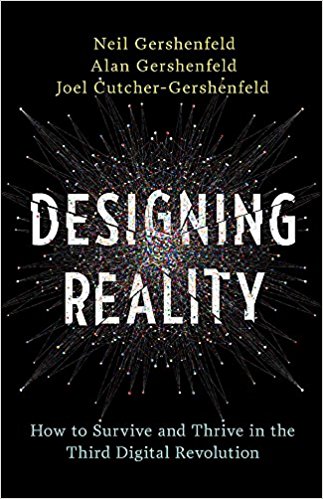
Designing-RealityThe first two digital revolutions — computing and communications — transformed society. Now comes the third, which is fabrication, argues the new book, Designing Reality. The authors say that computerized fabrication such as 3-D printing is the beginning of a trend to change data into objects. But like any revolution, not all populations will benefit equally. The book, which is aimed at helping people prepare for the next tech wave, was written by three brothers: Alan Gershenfeld, president of E-Line Media and former chairman of Games for Change; Joel Cutcher-Gershenfeld, a professor at Brandeis University; and Neil Gershenfeld, who heads The Center for Bits and Atoms at MIT. Alan Gerhsenfeld and Cutcher-Gershenfeld talked about their book on the Knowledge@Wharton show, which airs on SiriusXM channel 111. (Listen to the full podcast using the player at the top of this page.)
An edited transcript of the conversation follows.
Knowledge@Wharton: What started this third digital revolution?
Alan Gershenfeld: It’s actually a continuum. We’ve had a revolution in digital computation, we’ve had a revolution in digital communication, and both have changed the world. We use Gordon Moore’s 1965 paper as a powerful point, where he was looking back 10 years at the doubling of digital computing performance and projecting what would happen 10 years forward if that exponential curve continued. He predicted things like mobile phones and smart cars, not because he was Nostradamus. He was simply observing a past trend of technology doubling and projecting forward.
Well, it’s happened for 50 years with close to a billion-fold improvement. Our middle brother, Neil, who wrote the book Fab that introduced a lot of this technology to the world, has also looked back 10 years and seen the doubling of digital fabrication performance. When we project forward 10, 20, 30 or 40 years and a potential billion-fold improvement in digital fabrication performance, it will once again change the world. That is the third digital revolution.
Knowledge@Wharton: Where will average people be able to see these changes?
Joel Cutcher-Gershenfeld: If you’re involved in a community fabrication lab or maker space, you are starting to see it already. Most people barely see it except for press reports on 3-D printing, which is just one small piece of the puzzle. But where this is headed will affect how we live, learn, work and play. Imagine communities being able to design and make what they need locally, cutting global supply chains, still being globally connected but locally self-sufficient.
There are a growing number of communities that are beginning to embrace this rapid prototyping technology as a vehicle to make hydroponics for food, to make furniture, to make other things and, ultimately, to rethink the very nature of who owns the means of production. It started with Barcelona three years ago, and now there are about 14 cities in two countries that have set a goal of being globally connected but locally self-sufficient by 2040.
“The third digital revolution, much like the first two digital revolutions back in 1965, is largely going unnoticed or not fully understood.”–Alan Gershenfeld
Gershenfeld: There are pockets of knowledge, but the third digital revolution, much like the first two digital revolutions back in 1965, is largely going unnoticed or not fully understood. 3-D printing is a very powerful additive technology and one component of a fab lab. But there are some subtractive processes like laser cutters and shop bots, and there’s embedded computing. Right now the fab lab, as an integration of additive, subtractive, embedded computing, with a global network that is sharing a similar footprint of not just hardware but computer-aided design (CAD) and computer-aided manufacturing (CAM), creates a footprint that is interoperable, and you have something of an internet of bits and atoms.
That is partially what enables the exponential propagation of fab labs and global sharing with local self-sufficiency. Amidst all of the hype around 3-D printing, that landscape is misunderstood. The book gives a peek around the corner into the future of the research roadmap for digital fabrication, which goes from community fabrication to personal fabrication to ubiquitous and universal fabrication. In that process, there’s a switch from the materials used.
Now you use various forms of wood or MDF, plastics that are both environmentally friendly and unfriendly. Over time, those materials will become smarter. You’ll have smart digital materials that can form and reform, and that’s also part of the roadmap to sustainability. While there is awareness and press around 3-D printing, fab labs and maker spaces, folks don’t necessarily understand the full capability of a fab lab and the roadmap within the next 10, 20, 30 years.
Knowledge@Wharton: What exactly is a fab lab?
Cutcher-Gershenfeld: If you walk into a typical fab lab, it might be twice the size of a woodworking or metalworking shop. You would see some computers for design, a laser cutter, a 3-D printer, a milling machine, a 3-D scanner. You would see a space where you could do electronics and make circuit boards to make programmable products. It wouldn’t look that different from the rapid prototyping facility that a manufacturing organization would have. The difference, of course, is that it would be open to the community. It might be in a school, a library, a community college, a university or a museum.
The important thing is that the roadmap extends 30, 40, 50 years. But there are things that you can do right now. Let’s take Pittsburgh, for example. It’s a steel city that had fallen on hard times with the decline of traditional manufacturing. About 10 years ago, a series of pancake breakfasts brought educators together because they said kids weren’t learning the way they used to. They shifted to focus more on project-based learning.
Today there are 2,000 educators in that region, which includes western Pennsylvania and parts of Ohio. There are also about 200 fab labs and maker spaces, and they’re connected to the local schools, including Carnegie Mellon and the University of Pittsburgh. This digital fabrication capability is part of a new project-based way of learning that is integral to that emerging ecosystem.
Knowledge@Wharton: It sounds like education is a major component of the third revolution.
Cutcher-Gershenfeld: That’s exactly right. Fab labs are a great place to design and make things. It also turns out they’re a great place for people to connect and collaborate, both locally and internationally, because people are sharing designs and ideas all around the world through the digital communications connections. So, fab labs turn out to be centers for collaboration that really bridge across generations, across communities, in ways that are very special.
“Could there be a debilitating fab divide that actually makes the current digital divides even worse?”–Alan Gershenfeld
Knowledge@Wharton: Explain the process of writing this book together as three brothers who have complementary skills?
Gershenfeld: It was an interesting experience. Neil has always been on the vanguard of technology and digital fabrication technology and this nexus between bits and atoms. But he is a techno-utopist like a lot of people on the vanguard of technology. One thing that Joel and I do is look at the challenges and tensions in the global fab-lab ecosystem. As Joel mentioned, when you go to a fab lab it’s an exhilarating experience. A well-run fab lab has all of the benefits of experiential learning and community empowerment. You’re connected to a global community that loves to make things. It really is a powerful experience. But digital fabrication is hard.
First, we talk about access. Right now, there are over 1,000 fab labs reaching a couple of hundred thousand, perhaps a few million people, but there are 7 billion people on the planet. Could there be a debilitating fab divide that actually makes the current digital divides even worse? We go into a deep dive as to how to start to think about avoiding a fab divide now. Imagining going back to 1965, reading Gordon Moore’s paper and saying, we need to start thinking about a digital divide now, not 20, 30 years later.
We also look at literacy. Right now, digital literacy is still something we’re trying to define a half-century after Moore’s paper. What does it mean to be fab literate when that’s going to mediate so much of how things are made in the future? We look at things like an enabling ecosystem, how to cultivate fab mentors, how to cultivate interoperability. Right now there’s a lot of friction in the CAD, CAM, additive, subtractive, embedded computing process because they are very different. These traditionally have been different systems that don’t necessarily work well together. Designing standards and protocols is much easier early rather than later when they become hardened.
Lastly, we look at risk mitigation. That’s everything from bad people making bad things in a fab lab, which certainly you start to see press around, to other areas of risk that could emerge in the ecosystem. Again, now is the time to begin addressing those.
Knowledge@Wharton: Is it hard to look so far down the road without being retrospective and almost behind the curve?
Cutcher-Gershenfeld: In society, institutions hold what you might call the rules of the game. Institutions are a product of patterned behaviors that essentially become codified into how we do it. The institutions around digital communication and computation were slow to emerge. As a result, we’re playing catch-up now on all of the online bullying, complicated weaponized information and just the basic digital divides around access and literacy.
What we’re saying in the book is that now is the time to begin thinking about these patterns. Institutions need to do two things: They need to help create value, and they need to mitigate risk. Creating value is all about people being able to design and make what they need. There are serious risks. Probably the most troubling is bio-fab, which is using digital fabrication capabilities to create biological things. It’s beneficial if you can print a new liver, which in labs people can do. It’s not so good if you print a disease that gets out of the lab into the community. We need to create the institutional patterns, the new arrangements, to have conversations, to have advocacy, to have voice, to have agency with respect to the technology.
“We’re playing catch-up now on all of the online bullying, complicated weaponized information and basic digital divides around access and literacy.”–Joel Cutcher-Gershenfeld
Knowledge@Wharton: How will the third digital revolution change the way we work?
Cutcher-Gershenfeld: We think of work as getting paid to do a job, going to a workplace, having a supervisor, having a hierarchical structure and having a person who is the boss or owner. In some respects, there will still be services and things that you will need to do for which paid labor will be important in the years to come. It will be a blended economy.
But what’s interesting is that increasingly there are things that you can design and make for barter and exchange. The very notion of work itself may be that you can do paid work less and consume less, and instead create more.
Gershenfeld: For years, indigenous communities have been able to understand their environment, understand their local materials and largely make what they consume. I think a global movement, like the fab cities movement, that is looking back to that sort of true north. How can we increasingly use local materials to largely make what we can consume? As Joel mentioned, that leads to a really interesting blend that is going to emerge. There’s the idea that, with making more of what you consume, with more protections around the gig economy, you can have a more blended lifestyle where it’s not this dichotomy of work and not work.
Knowledge@Wharton: How will all of this affect societal norms?
Cutcher-Gershenfeld: Let’s take a function in the workplace that we know well: human resources. Human resources ensures fair treatment in the workplace, health and safety, helps define career paths, attends to training and development. All of those things depend on there being something called a workplace in the first place. These fab labs aren’t a workplace, so they’re not subject to health and safety regulations, the laws governing fair treatment, discrimination, and so on. Yet people are spending a lot of time there, and those issues and needs are real. That’s a place where the institutions needs to be realigned to match the new realities to protect against the parts of our human nature that are not always the best version of ourselves.
At the same time, the technology itself will eventually move out of the lab as we go along this roadmap into more personal technology, which could be located anywhere. How do we ensure fair treatment, safe conditions and other societal norms that we value in a world where the ability to make things is increasingly mobile?
Gershenfeld: Right now in society, there seems to be this big dichotomy between globalism and localism. Fab labs are almost a boundary object where bits can be global and we can share global knowledge, but atoms can be local and self-sufficiency can be local. I think it’s a way to break down some of those hardened divides.

2017/05/17

How the WannaCry Attack Will Impact Cyber Security

rane
The worldwide cyber attack that began last Friday and goes by the name of “WannaCry” has highlighted the need for governments and businesses to strengthen their security infrastructure, in addition to calling attention to the need to mandate security updates and educate lawmakers about the intricacies of cyber security.
At last count, WannaCry had affected more than 230,000 users in some 150 countries. Prominent among the victims of the attack are the National Health Service (NHS) in the U.K., which found many operations disrupted and had to divert patients to other facilities, Spain’s telecom company Telefonica, U.S.-based FedEx and organizations in South America, Germany, Russia and Taiwan. Aside from FedEx, the U.S. was surprisingly spared, thanks to an alert researcher who discovered a “kill switch,” or a way to contain the spread of the attack. The hackers behind the attack have been demanding ransoms of $300 in bitcoins from each affected user to unscramble their affected files with threats to double that if payments are not made within 72 hours.
Meanwhile, threats of similar – or perhaps worse – attacks have continued to surface. “This was not the big one. This was a precursor of a far worse attack that will inevitably strike — and it is likely, unfortunately, that [the next] attack will not have a kill switch,” said Andrea M. Matwyshyn, professor of law and computer science at Northeastern University. “This is an urgent call for action for all of us to get the fundamentals finally in place to enable us to withstand robustly this type of a crisis situation when the next one hits.”
The WannaCry attack targeted users of Microsoft Windows XP, which Microsoft had discontinued and stopped putting out patches for in 2014. “It shows the dangers of using outdated software,” said Michael Greenberger, law professor at the University of Maryland and founder and director of its Center of Health and Homeland Security. “As the devastation of these events takes place, you are going to see more insistence on the following of practices that keep software updated,” he said. “Mandating that certain software be [updated] may sound rough to the ear, but when you see people dying on the operating table because the software is inadequate, [such mandates will] become much more acceptable.”
“This was a precursor of a far worse attack that will inevitably strike — and it is likely, unfortunately, that [the next] attack will not have a kill switch.”Andrea Matwyshyn
Matwyshyn and Greenberger discussed the emerging approaches to preparing for future cyber attacks on the Knowledge@Wharton show on Wharton Business Radio on SiriusXM channel 111. (Listen to the podcast at the top of this page.)
Matwyshyn noted that “security researchers are absolutely critical to the safety of our future systems.” She pointed out that in the U.S., the attacks were contained because of the efforts of such a researcher. The researcher, tweeting as @MalwareTechBlog, said the discovery was accidental, but that registering an unregistered domain name used by the malware stops it from spreading. “This one person, with an expenditure of approximately $11, saved many from being attacked by this ransomware,” said Matwyshyn.
Meanwhile, the NHS in the U.K. continues to grapple with the crisis, even as it installs the requisite software updates on its computer systems. Microsoft on Friday released updates for computers that use the Windows XP, Vista, Windows 7 and Windows 8 operating systems.
High Cost of Delays
Matwyshyn worried about organizations not heeding the urgency of the current situation, and therefore delaying the required updates. “There is a real risk that there are some businesses or other system administrators who might be living under the proverbial rock who won’t engage with the urgency of the situation, and we will see a stream of infections to come,” she said. Greenberger agreed about the dangers facing slow responders. “We’re going to see more; we’re going to see worse, and when we do, the remedies will be much more demanding.”
According to Matwyshyn, the WannaCry attack brings fresh urgency to Microsoft’s call for a Digital Geneva Convention, or an equivalent of the treaties signed after World War II to ensure humanitarian treatment of civilians and other prisoners during times of war. Microsoft wants a formal, international agreement on digital security because of what Matwyshyn termed as “the problem of reciprocal security vulnerability.” That refers to the difficulty of differentiating between a security problem in the public sector and one in the private sector, she explained.
International agreements may also deter errant governments from causing such attacks. In fact, the WannaCry hack appears to have been engineered by North Korea. On Monday, Neel Mehta, a security researcher at Google’s parent company Alphabet, found similarities in the codes used in a WannaCry variant and the 2014 attack on Sony Pictures and a 2016 attack on a Bangladeshi bank, the Wall Street Journal reported. Those attacks were attributed to a North Korean hacker organization called Lazarus Group. Security firms Kaspersky, Symantec and Comae Technologies later said they, too, found such similarities that pointed suspicions at Lazarus.
The latest attacks also reveal the risks posed by governments in managing security threats. The attacks have been traced to the leaks earlier this year of a collection of hacking tools that the U.S. National Security Agency had put together. “Microsoft’s position appears to highlight that … the means of digital compromise that are leveraged by governments also impact the private sector and have follow-on consequences,” Matwyshyn said. Added Greenberger: “The good news is, because large corporations are driving discussions on this subject, it takes the issue out of the hands of nation-states, and the chances of getting agreements are much better.”
Matwyshyn also emphasized the need to get the private sector up to speed with the patching cycles and the risks they face, with a particular emphasis on industries that are not traditionally technology-driven. She noted the risks to human life, especially as thousands of medical operations were disrupted in the U.K. “Unfortunately, mass death is an inevitable consequence of this type of future attack,” she warned.
According to Matwyshyn, the security response calls for nothing less than a top-down effort from the C-Suite, “where security is treated as a fundamental piece of the structures within a company, because information security is only as good as the weakest link.” She said companies must have chief security officers and vest them with sufficient powers and social capital to be able to articulate needs in terms of staff, training or other investments.
“Mandating that certain software be [updated] may sound rough to the ear, but when you see people dying on the operating table because the software is inadequate, [such mandates will] become much more acceptable.”–Michael Greenberger
“This attack demonstrates the degree to which cyber security has become a shared responsibility between tech companies and customers,” noted Brad Smith, Microsoft president and chief legal officer, in a blog post.
A Call for Mandates
Greenberger called for government mandates on security updates, adding that he often sees much “lip service” paid to ensuring adequate security but little in the way of real action. The government must disallow the use of certain types of software and require users to certify that they comply, and assistance must be provided to smaller entities that don’t have the resources, he said. “It can’t be an unfunded mandate.”
According to Greenberger, lawmakers, too, are ill-equipped to prepare adequately and in a timely fashion to future threats. He recalled that he had encountered those obstacles to counterterrorism measures on Capitol Hill before 9/11 occurred. “A calamity happens, and it does [get the requisite attention],” he said. He noted that in dealing with state legislatures, the lack of sophistication in dealing with such problems is “really quite remarkable,” and he suggested the need for the requisite education and training or whatever else it takes to bring lawmakers up to speed with the requirements.
Matwyshyn pointed out that another problem is “we have a rudimentary understanding of the scope of the problem.” She noted that the ways in which numeric indexing of security vulnerabilities are created are not keeping pace with the reality of the known vulnerabilities. “We need to figure out the basic infrastructure around identifying, numbering and getting the word out about the vulnerabilities that we know to exist,” she said. “We don’t even have that in place yet.”
Indeed, the World Economic Forum’s Global Risk Report 2017 had highlighted cyber security as a top risk factor. “Today’s technologies enable data to be immediately leaked over, say, a Twitter feed,” Howard Kunreuther, co-director of the school’s Risk Management Center, which prepared the WEF study, told Knowledge@Wharton previously. “How safe our technology is, is going to be an important risk for us to consider.”

2016/02/08

Why the Best Technology Isn’t Always the Winner

gamesAnyone who has watched the evolution of technology knows that sometimes, clever new technologies emerge and quickly supplant the incumbents, while others may take years or decades to take off — if they gain widespread traction at all. So for investors, consumers and businesses, the key question is: What is the differentiating factor between the fast winners and the slow losers?
In their paper, “Innovation Ecosystems and the Pace of Substitution: Re-examining Technology S-curves,” published in the Strategic Management Journal, Wharton management professor Rahul Kapoor and Ron Adner, a professor at the Tuck School of Business at Dartmouth College, attempted to answer this question by examining not just competing technologies, but also the ecosystems in which they were embedded. And they have come up with a solid hypothesis. Kapoor recently talked to Knowledge@Wharton about the implications of their findings for businesses, governments and consumers — both early adopters and the patient mainstream.
Edited excerpts from the conversation appear below.
A Question of Adoption
This research is really looking at a puzzle that we observed, in terms of new technologies being introduced into the market: There are significant differences in terms of how fast they are able to reach mainstream adoption and disrupt existing markets and players. For example, we observed that in the printer space, inkjet printers came about quickly, and rapidly overtook the dot matrix. Then look at HDTV: It took decades for it to achieve mainstream adoption. And then, you can look at things like the Segway, or the Palm types of technologies, which either created some value, or never really reached mainstream adoption.
So the question was really, what explains why some technologies are introduced and immediately supplant the existing technologies, whereas others take decades, or sometimes don’t reach mainstream adoption at all? We tried to find a context where we could observe enough variation in terms of how quick or slow these technology adoption patterns were — but one that helped us to control for a lot of confounding effects, as well. The idea was to find a natural experiment, so to speak. And that helps us to ensure that the source of adoption is not driven by some systematic effects, which we could not observe, and which may make inferences more problematic.
“When you think about the batteries used in electric cars, you must also think about charging stations, and the garages that can fix those electric cars.”
I had some experience in the semiconductor industry, and we came across semiconductor lithography as a technology that would allow us to study this question. What is interesting about the setting is that it’s the engine behind Moore’s Law. Any progress in semiconductors over the last 40 years has been fueled by lithography technology, so it’s important. We know it’s fast-paced, and we thought that it was where we might want to study this question.
We studied 10 different technologies that were introduced in the semiconductor lithography industry over a 40-year period. We interviewed about 30 industry experts to try to get a sense for what drove the different patterns of market adoption. We collected data on technologies, markets, firm, in an effort to really try to understand the factors that might explain these differences. What we found was interesting. You know, a lot of the research and practice focuses on new technologies, and how they interact with the markets. It looks at the question, is the technology better than what’s available now, or not? And that is viewed as explaining whether it’s going to reach mainstream adoption.
We found that is part of the explanation — actually, in our case, a very small part of the explanation. We found that the bigger explanation was not to be found in the new technology, and the market, but within the technology ecosystem: How is the technology created? What are the different elements that make up the technologies?
Another question is, how is the technology used, in terms of other elements or complementary technologies and services? So when you think about the batteries used in electric cars, you must also think about charging stations, and the garages that can fix those electric cars.
And not only that: You need to look at the technology ecosystems for both the new technology and the old technology. What we set out as our goal was, we wanted to explain this variance. What we saw from our field work and heard in our interviews, that by looking at the technology itself, the resolution in terms of whether adoption is going to be fast versus slow is not going to be very clear. So instead, we said, let’s look at the ecosystem. We collected data that systematically described each technology in terms of its ecosystem, and compared it to the pre-existing technology.
When it comes to new technology, there is sometimes what we call an ecosystem emergence challenge: The technology is ready, but the ecosystem still needs some investments, like the charging infrastructure for electric cars, for it to reach mainstream adoption.
But with the old technologies, we also saw that sometimes, you can extend their lifespans by making improvements in components, or in complementary elements. Think about gasoline cars, for example: Nobody thought, 10 or 15 years ago, that they would be getting 30 miles per gallon or even 40 miles per gallon today. But improvements in engines, improvements in fuels, allowed them to get to that point.
Think about the hybrid versus electric car discussion: The hybrid cars introduced were able to grow market share much faster than electric cars. And the main difference was, the hybrid cars could plug and play. There wasn’t an emergence challenge in the ecosystem. Electric cars had these emergence challenges around creating the infrastructure, because they didn’t have the charging stations in place.
After doing this research, we were able to document fairly clearly that if one wanted to understand the likelihood that a new technology was going to come in and immediately disrupt the marketplace, versus taking much longer or that disruption maybe never happening at all, you had to look at the new technology’s ecosystem in terms of emergence challenges, and the old technology’s ecosystem in terms of its extension opportunities. It’s really the joint consideration of these two factors that explains whether you will see a technology make a fast takeoff, or a technology that will never reach mainstream adoption.
Key Takeaways
I think the research presents some very interesting takeaways for managers, for policymakers, for investors in technology companies, and also for users of technologies, whether they are consumers or businesses. If you are a manager of a firm, whether it’s a new start-up or it’s an established firm, you always have to think about the resources that you’ll have to allocate towards new technologies, and how you transition from an existing to a new technology.
Think about how Kodak shifted from chemical-based photography to the digital photography arena. Think about Netflix moving from a DVD rental business to the online streaming business. Managers can use this framework to set realistic expectations in terms of both whether and when to invest in new technologies. Sometimes, not jumping to the new technology actually makes sense. They will generate more shareholder value, or destroy less shareholder value, by focusing on the existing technologies, rather than going all out and pushing for the new technology.
From an investor’s perspective again, it sets realistic expectations when you are investing in technology companies, in their ability to create value over time. Sometimes the expectations could be two years. But as we know, it often takes much longer than that for new technologies to create value.
“To understand the likelihood that a new technology was going to come in and immediately disrupt the marketplace … you had to look at the new technology’s ecosystem in terms of emergence challenges.”
As a user, you have to make the same sort of decisions, whether you’re a business or a consumer. You’re always up against the decision: Should we go for the latest and greatest, or should we wait until the new technology has developed to a point where it creates value? Having the sensibility in terms of understanding the existing ecosystem and new ecosystem can help them make more optimal decisions.
For policymakers, this is a big question in terms of the role of policy in shaping technological progress. We know that a lot of economic progress is driven by improvements in technology. So if you run into a scenario where new technologies are not emerging at the rate where you expect them to emerge, that has a downside in terms of jobs, in terms of economic output, in terms of GDP growth.
So thinking more in terms of ecosystems, both for new technologies and existing technologies, helps all of these actors get better returns on their investments, and get fewer surprises in terms of expectations.
Building a Better Forecast
It was our intention to refine our ability to forecast how technologies are going to evolve over time. The title of the paper mentions S-curves, because those are a way people have thought about it.
There are two different ways people thought about forecasting technological changes. One is thinking about the performance improvements of the technologies, and we know that those performance trajectories tend to take an S-shape. Early stage, you invest a lot, but you’re not getting improvements. Then there’s a takeoff where you expect most of the market takeoff. And then there’s maturity.
Similarly, there is an adoption S-curve, which is that during the early state of a technology, the users who are going to be going after it are not the ones who really care about the total value — they just like the new technology. That’s a very small part of the market. The mainstream users are looking to see, what’s the main value proposition? Not just technology being new. And that depicts an S-shape distribution as well.
So what we were up against is these existing frameworks and tools, which have these nonlinear, S-shaped dynamics. What we are able to show through this ecosystem-based lens is that the pattern of these evolutions, both in terms of technology improvement and market adoption, may not fit well with a smooth S-shaped trajectory. There often could be discontinuous patterns. Having this sensibility can help you predict whether the S-shapes are going to be smooth and evolve quickly, or whether the curves may not be S-shaped, and may actually get resolved in a much longer time frame.
Where I’m going with this project is to have a model and an approach that helps us to improve technology forecasting. In fact, one of the things I was surprised by when we were doing this research was the amount of resources that both companies and governments were expending into these new technologies — often running into hundreds of millions of dollars. As you know, the semiconductor industry is very capital-intensive.
And despite these resources and expectations, they had well-documented industry roadmaps that said these new technologies were going to be hitting the mainstream in three to five years. More often than not, they would take twice that amount of time, and in many cases, never take off at all. That’s something that I was not expecting as much. I was expecting some of it, but not at the scale that I observed.
The other issue that I thought was pretty surprising is, we kind of write off existing technologies and old technologies. The cell phone? Nobody’s going to use it. Everybody’s going to shift to tablets and newer ways to do things. But seemingly geriatric technologies continue to create a lot of value for a very long time, which was a counterintuitive finding considering what we expected to see in this research.
Advice for Business
I think from a firm perspective, the big implication is thinking about resource allocation, and whether it makes sense for firms to go all out on these new technologies at the rate that they expect to invest. The other implication from a firm perspective is timing. You know, in a related study, I was able to document that the “first mover advantage,” which we often claim exists in many technology settings, turns out not to [exist]. In fact, we were able to show a significant first mover disadvantage in technologies where the ecosystem emergence challenge was so high, the first movers couldn’t create any value. So issues of timing were important.
“Sometimes, not jumping to the new technology actually makes sense.”
Another issue that I think managers and investors need to think about: A technology is seldom a single artifact, or a single technological element. It is an ecosystem. That makes it very difficult for a firm to control all the elements that go into creating value from their technology.
So one sensibility that I’d like to share with the managers and investors is this. As we think about evaluating technological opportunities, it’s not enough to look at just the focal technology — whether it’s the phone, or it’s the computer, or it’s the car. You have to think about the ecosystem. What are the elements that go into it? And could you orchestrate the ecosystem in a way that mitigates these potential downsides of users not deriving value when the technology is ready?
You know, what was particularly interesting from our study was, every time a new technology was introduced, the technology was actually superior in terms of performance. But despite that, it never reached mainstream adoption. And the explanation for why was really rooted in the ecosystem of the new technology versus the ecosystem of the old technology.
Why the ‘Better Mousetrap’ Doesn’t Always Win
We had a case where a new technology came in with three times, four times better performance. But a critical element that the users needed to use it wasn’t there. So consider it like this: Think of this superior technology as a camera. You need the film. But the film that is available is not good enough for you to get the full potential of this new camera. So users don’t really see an incentive. You’re coming up with the best camera, but with the below-par film available, the total value proposition is not there.
In other cases, the technological advances are fairly incremental, but users are able to plug and play. Like a hybrid car, for example. That doesn’t see this sort of resistance and friction in the marketplace.
From a venture capital perspective, as we think about these entrepreneurial ecosystems as a way for venture capitalists to get in and create value — you cannot just localize on a single firm as a basis of investment and value creation. If you think about e-books as a case in point, a lot of companies like E Ink, back in the day, were funded through a lot of VC money. Both private venture capital and also corporate venture capital.
But it wasn’t about the electronic ink. It was about content. It was about the reader. It was about Amazon’s business model, which had to bring the solution together. So as we think about the opportunities for venture capital for any given technology, it’s not enough to just focus on new technology. We should be thinking about the broader ecosystem, and how one could control and drive progress through the ecosystem.
Buying into the Hype
You see quite often overly optimistic, aggressive expectations about new technologies. Some people refer to it as the ‘hype cycle.’ I think we are able to identify the reasons for those hypes. And just calling something a hype is not enough, in my view. It’s understanding the factors that drive the hype, and then using that as a basis for making good decisions.
There were clearly very high expectations in our research context that these technologies would reach mainstream adoption. We were going to be investing millions if not billions of dollars into these technologies. But it turned out those investments were in vain, because either the ecosystem didn’t emerge at the right time, or at a cost that made it attractive to the users.
The second misperception is that people have these very dramatic views about the decline of the old technologies, and their framing of the world as a world of disruption — the idea that all the value is going to be created through creative destruction coming from new technologies. We do feel that that part of the world is a bit oversold. In fact, a lot of the value in semiconductors — and in many of the other industries that I’ve studied — is being created through continuous innovations and finding market opportunities for existing technologies. We’ve found that in our context as well. There’s a very interesting company called Ultratech that has been in the semiconductor industry for 40 years. It has never been at the cutting edge of the technology, like some of its peers that entered and exited in a fairly short span. But this company has existed for a very long time, and is still creating a lot of shareholder value.
“You see quite often overly optimistic, aggressive expectations about new technologies. Some people refer to it as the ‘hype cycle.’”
So I think those perceptions, in terms of an overly optimistic view of the new technologies, and a very pessimistic view about the value proposition in old technologies, are something that we think needs to be more balanced, as opposed to these extreme views.
Breaking New Ground
We are certainly not the first ones to study new technologies and their ability to create value in the marketplace. But I do think that we are one of the first, if not the first, to bring attention to the important role of the ecosystem in the way technology gets developed and commercialized, and to really understand how these technologies transition. We think it’s not enough to just take the ecosystem perspective – you must also look at both the new technology ecosystem and the old technology ecosystem. It’s really bringing these two ecosystems together as an analytical framework that can generate a lot more valuable insights, in our view.
The other aspect of the research that I’m particularly proud of is the approach that we took to study this question. It required almost two years of field work. We interviewed more than 30 industry practitioners — managers, consultants from a variety of roles in the ecosystem. And that took a lot of time. But we felt that we were able to generate a set of robust findings that made that effort worthwhile. That’s something that we don’t often see in a lot of management research.
What’s Next
This was, in my view, probably a first step for me to try to think about how one could make better decisions in terms of new technologies, and provide a framework that could guide that decision-making. We’re still not quite at the point I would like us to be, in terms of our ability to forecast technologies — both existing and new — and to take a more probabilistic view that can guide managerial decision-making, venture capital investments, and even help policymakers think about.
What I’m moving on is to take the issue of technology forecasting more seriously. Anecdotal evidence suggests that we’re actually very poor technology forecasters. I mean, there’s not a lot of documentation in terms of accuracy of forecasting. But if you look at some of the big technology forecasts that come out, nobody tracks them — which is a problem, of course. But anecdotally, you can tell that a vast majority of them turn out to be wrong, in terms of missing the timing completely, or missing the new technologies that nobody predicted three to five years ago.
So my goal is to think about the theoretical logic, but also think about an approach that helps us to predict new technologies in a way that we have not been able to do so far. I’m starting with the auto sector, which is going through some fairly interesting shifts at the moment. It has been shifting towards electrification, and now we’re talking about autonomous cars. We have the technology companies coming into it, in addition to the auto sector. It’s an environment that presents a lot of uncertainty, but also a lot of variability in terms of technological choices being pursued.
So I’m working on a project where we will try to create good forecasting models, and hopefully we can show their accuracy in predicting the course of many of the technologies being pursued in the auto sector. The hope is that we’ll be able to take that as a template, and apply it in other technology settings. You know, think about the Internet of Things, think about wearable technologies. Think about financial technologies. We could scale this model to make better technology forecasts in all of them.