Mostrando las entradas con la etiqueta Goldman Sachs. Mostrar todas las entradas

2019/04/16

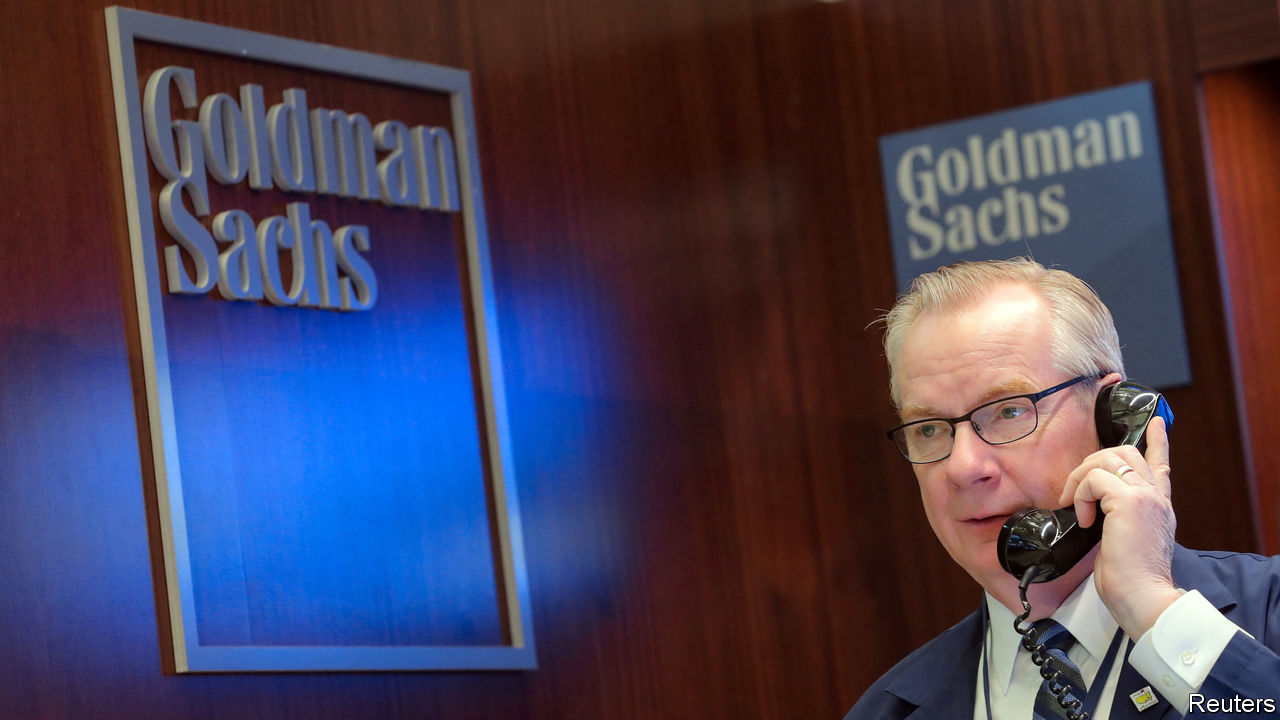
A new era at Goldman Sachs starts in the shadow of a scandal

Can the bank reinvent itself?

NO ONE IS more aware of the value of a brand than Goldman Sachs. The investment bank, founded in 1869, has advised the biggest and best American companies on the value of theirs for the past 150 years. It helped F.W. Woolworth, a pioneering department store, with its initial public offering in 1912. It took Ford and Disney public in the 1950s, helped Amazon buy Whole Foods in 2017 and will take Uber public later this year. Yet these are troubling times for its own brand, tarnished by association with a fraud-ridden Malaysian state-run fund, 1MDB, and hurt by the bank’s failure to adapt after the global financial crisis.

These issues were echoed in the firm’s first-quarter results, released on April 15th. Revenues came in below expectations—13% lower than for the first quarter of 2018—largely as the result of lower trading revenues. The share price fell more than 3% and the earnings call was peppered with analysts asking questions about 1MDB.

The first task for David Solomon, who took over as chief executive last October, is to clean up Goldman’s reputation. In 2012 and 2013 it helped 1MDB raise $6.5bn across three bond offerings, earning $600m in fees—way above the norm for such work. American and Malaysian authorities have alleged that much of the money raised was stolen in a scheme masterminded by Jho Low, a Malaysian financier. He has denied wrongdoing (and vanished).

Last November America’s Department of Justice (DoJ) announced that a former senior partner at Goldman, Tim Leissner, had pleaded guilty to conspiracy to launder money and to violate foreign bribery laws. And they indicted Mr Low and another former Goldman banker, Roger Ng, who has also denied wrongdoing. Goldman claims that Mr Ng and Mr Leissner, who transferred embezzled funds into his personal bank account, kept the bank in the dark about their actions.

But criminal charges have been filed against the firm in Malaysia. Though Goldman is contesting the case, it is spooking shareholders, who worry about both onerous fines and what it implies about oversight at the bank. Since November its share price has underperformed an index of other bank stocks by 10.3 percentage points, suggesting that the scandal may have wiped as much as $9.1bn off its value.

It is against these headwinds that Mr Solomon must try to convince investors that Goldman can reinvent itself. Its peers have already digested the fact that Wall Street’s traditional model, in which banks advise on huge corporate deals and make bold trades on their own behalf, has become less profitable. According to Michael Spellacy of Accenture, a consultancy, 90% of the economic profit made in the capital-markets industry is now earned on the buy side—that is, by those who manage assets or investments—and just 10% from sell-side investment-banking activities. A decade ago, he says, that split was closer to 50-50.

Goldman’s slowness in reacting to these structural changes has allowed its competitors to catch up. In 2010 its return on equity (ROE) was 11%, easily beating the 8% average for “bulge-bracket” American investment banks, a group including JP Morgan and Morgan Stanley. But last year that group averaged an ROE of 11.2%, placing Goldman, at 12%, near the middle of the pack. And investors are becoming concerned about the way it earns its returns. Volatile profits, like those from trading businesses, mergers and acquisitions, are considered less valuable than steady fee-based income, for example from wealth management.

In 2016 Mr Solomon’s predecessor, Lloyd Blankfein, took the first steps towards a new strategy by launching a consumer bank, Marcus. In 2017 Goldman announced a target of increasing yearly revenues by $5bn by 2020. But the focus on expanding consumer lending, which offers a relatively low return on investment, did not impress shareholders.

They have had a rough ride. Holding shares in the firm since 2010 would have earned just 13% (without adjusting for inflation), compared with an average of 71% for its bulge-bracket peers and 152% for the S&P 500. Goldman continues to trade at just 0.9 times its tangible book value, a measure of the money that might be returned to shareholders if it were liquidated. The average ratio of price to tangible book value for a bulge-bracket bank is 1.15.

As far as 1MDB is concerned, the big worry for shareholders is the size and scope of the penalties. A large fine is all but inevitable. It could be based on the $600m Goldman earned from the bond issuance—or the $2.7bn American authorities say was stolen from the proceeds. That will be multiplied by anything up to four, depending on the degree to which the firm is found culpable. That Goldman is co-operating with the DoJ will bring the multiplier down; if the DoJ decides the firm’s oversight of compliance procedures was inadequate, it will be towards the higher end. Steven Chubak of Wolfe Research, an equity-research firm, thinks the total will be somewhere between $1bn and $4bn.

When it comes to the required shift in strategy, however, Goldman’s efforts may soon start to bear fruit. Its expansion into consumer businesses is continuing apace. In 2018 it acquired Clarity Money, a personal-finance app. Last month Tim Cook, Apple’s chief executive, announced that it will launch a credit card with Goldman this summer. When Marcus launched it was as a consumer lender; since then it has added deposit-taking. Though it offers market-leading rates, deposits are still a cheap source of funding. In 2012 just 8% of Goldman’s funding came from deposits. Last year that share had risen to 19%. If it can keep replacing wholesale funding with deposits at the pace of the past five years, says Mr Chubak, it will have reduced funding costs by $500m by 2022.

The consumer space is not the only place Goldman is rolling out new technology. More than a quarter of Goldman’s employees are now engineers, says Heather Kennedy Miner, the bank’s head of investor relations. The firm has deployed a new platform, called Marquee, for institutional investors and will expand into corporate cash management in 2020, which will further increase low-cost deposits. 

The firm also seems to be planning an overdue restructuring of its fixed-income, currency and commodities (FICC) business. Revenues earned from FICC have fallen from $13.6bn in 2010, accounting for more than a third of Goldman’s revenues, to $5.9bn now, or just a sixth. Last October Stephen Scherr, Goldman’s newly appointed chief financial officer, announced a review of all its business lines, which will be published early next year. In February the Wall Street Journal reported that the commodities business would be scaled back. (Mr Scherr emphasises that Goldman has no plans to abandon commodities entirely, as some of its competitors, including JP Morgan and Morgan Stanley, have.) In March Mr Solomon announced plans to cut the number of staff in sales and trading by 5% this year.
Its new strategy will mean Goldman is competing on less familiar territory. 

Consumer deposits and corporate cash management are competitive markets that JP Morgan and Bank of America have dominated for decades. But they are also huge markets. Even a small slice could have a big impact on Goldman’s profits, says Mr Scherr. Compared with established banks, Goldman is able to develop and deploy new technology easily; but unlike startup digital competitors, its innovations are backed by a $925bn balance-sheet. America’s financial-services industry has been slow to adapt to technological change. An old bank with a new direction might be well-placed to disrupt it.

Economist

2018/01/12

How Goldman Sachs Is Moving the Needle on Diversity

diversity2
At a recent leadership talk at Wharton, Edith Cooper, Goldman Sachs’ global head of human capital management, recounted that years ago she had a reverse mentor who was gay. Before that time, she’d had little contact with anyone in the LGBTQ community. Cooper became close with her young mentor and as they talked one day, she ventured to ask her why it would be necessary to identify oneself at work as being gay. Wasn’t it instead “kind of what you do in your personal life?”
The mentor explained that if she didn’t come out to her co-workers, she would inevitably find herself in uncomfortable conversations about how she spent time outside the office. Even the standard Monday morning chat about “what you did over the weekend” would be fraught. While others talked about their husband or wife, the mentor would have to refer vaguely to some “friend” instead of “my partner” or “my girlfriend,” avoiding any details.
Cooper said that some might feel she shouldn’t have asked the mentor the question for fear of causing offense. But, she said, “I didn’t know, and I was in a safe place [to ask].” Cooper observed that from the conversation she gained greater tolerance as well as a deeper appreciation of “how important it is for people to bring their true selves to work.”
Enabling difficult but productive conversations about race, religion, nationality, gender, sexual orientation and disability among Goldman Sachs’s 35,000 employees is one of Cooper’s major goals. Cooper, who became an executive vice president at Goldman six years ago and has led the human capital management team since 2008, has appeared on the Most Powerful Women lists of both Crain’s and American Banker. It’s been noted that she is one of the highest-ranking black women on Wall Street. After stepping down at the end of 2017, she will remain one of Goldman’s senior directors.
The Elephant in the Room
Some may remember Cooper’s much-discussed LinkedIn Influencer post from about a year ago titled “Why Goldman Sachs is encouraging employees to talk about race at work – and why as a black woman I think this is so important.” The article generated nearly 17,000 likes and almost 2,000 comments.
“Anything that we do for our under-represented population benefits everyone.”
In it, Cooper candidly described some of her frustrations as a black woman in finance; for example, being asked to serve coffee at a meeting she was actually there to run, and being asked “how she got into” Harvard. She also recounted personal tribulations such as being mistaken for a coat-check worker at her son’s school, and of being told that she wasn’t “black black” because of her comfortable upbringing and professional success.
Cooper noted how she became motivated to write the article. “I’m in a role where I am responsible for the people of the firm … I just asked myself the question, if not me, who’s going to do it?” She felt she should relate her story in a way that encouraged others to share theirs.
Another motivating factor was recent events in the news. “We had come from a very difficult summer where two black men had been shot by police.” She believed, and her CEO Lloyd Blankfein agreed, that many black professionals at the firm as well as other employees might feel uncomfortable working at a company where there was “no real conversation” around diversity.
Around the same time the article came out, said Cooper, Blankfein sent a voicemail to Goldman Sachs employees calling for an internal meeting. In the message he basically said that he was troubled by recent events and wanted to ensure the firm was an environment where everyone could feel at ease and perform to their potential. Cooper described the meeting as “a real big game changer,” saying she would never forget the moment she saw that the large auditorium was packed, with people even standing in the aisles. Feedback afterward was overall positive, and the stories some employees shared with Cooper as a result were “incredible,” she said.
She got an email, for example, from a hearing-impaired colleague who had been concealing the disability, doing things like showing up to meetings a half-hour early to be assured a seat close to the speaker. “Now I feel comfortable saying to my boss, I can’t hear you unless I’m sitting next to you,” the person said. Cooper also heard from a Muslim colleague who had a Jewish last name because her husband was Jewish and had long had to tolerate certain co-workers’ anti-Muslim comments. The meeting inspired her to confront the behavior and offer a serious conversation about her religion instead.
Cooper pointed out that raising awareness about diversity not only improves employee morale and well-being but also boosts the quality of a firm’s work. “You’re sitting in a [meeting] room and you’re [suddenly] conscious of the person who’s different and never says something. Then you start realizing, ‘hey, I’m only hearing from the same two people, I’ve got to fix that.’” This leads to better ideas, better conversations, and greater impact, she said.
 The Black Analyst Initiative
Cooper added that it’s important to handle the human capital management process in a holistic way. Historically, Goldman had focused too much on recruiting — getting the bodies in the door — without really measuring how people performed over time. She noted that this wasn’t a productive approach for a commercial enterprise, and that on her watch she had worked to establish a continuum that linked recruitment, promotion, retention and advancement. “We pay attention every step of the way.”
“Who do you spend your time with in casual interactions? Literally, write it down at the end of the day.”
For example, the company had begun to improve its numbers in terms of hiring black analysts. But they weren’t staying. At one point she realized that in some divisions there were only one or two black analysts left. Cooper and her team looked at the data for this group of hires — including managers’ review scores, individuals’ review scores, candidate criteria and graduating schools — and found it to be the same or similar to the analysts who weren’t from under-represented populations. From this finding, Cooper said, her team concluded there was “something going on in the environment.”
Her response was to create a program called the Black Analyst Initiative, which brought together black analysts with their managers, coaches and sponsors to create more involvement in the person’s professional experience. According to the company’s website, the third annual Black Analyst Initiative was launched in the U.S. in 2016 and the program was inaugurated at Goldman’s EMEA (Europe, Middle East and Africa) offices the same year. Career development coaches work with participants and their managers to develop short and long-term career goals, consider mobility and networking opportunities, and discuss pathways to promotion.
“Now you might say, ‘wow, quite a lot of attention [was devoted to this]’,” said Cooper. But the program was structured in a way that benefited the people around the analyst as well, many of whom might never have managed someone of a different race or background before. “We all know that people have preconceived notions about [other] people before they even say anything,” Cooper said. “We really needed to break that down.”
She said that through the initiative, Goldman Sachs has seen a dramatic improvement in the retention of this group, made their managers better managers overall, and created “more opportunities for mobility” for all employees. “Anything that we do for our under-represented population benefits everyone.”
Cooper noted that Goldman Sachs today also has a number of “affinity networks,” including groups based on gender, sexual orientation, disability, Hispanic/Latino ethnicity, Asian ethnicity and veteran status.
Who’s Your Coffee Buddy?
The human capital management division under Cooper also provides unconscious bias training, which helps people become aware of both the negative and positive stereotypes that affect their behavior. “Human dynamics are complicated, and we haven’t until recently tried to tackle that,” said Cooper.
She described how all the partners, managing directors and vice presidents — around 16,000 people — recently underwent a two-hour unconscious bias seminar. This type of training, Cooper explained, is not meant to make people feel accused of being “a bad person … racist, sexist, homophobic” but rather to help them understand that each of us is a product of our life experiences.”
Those experiences lead us to seek common ground with people similar to ourselves. The resulting favor shown to people from similar backgrounds encircles them in cliques that shut out others who are “not getting that kind of love,” she said. The behavior could be something as unthinking as always going to coffee with the same person you went to school with, while never saying good morning to someone else.
Cooper called it an “aha moment” for many of her colleagues, and said the seminar offered specific tactics they could apply to combat unconscious bias in their day-to-day activities. “Who do you spend your time with in casual interactions? Literally, write it down at the end of the day. Look back at it at the end of the week,” she said. “Be honest with yourselves.” Participants were also advised to track who they tended to listen to in meetings, call on, and follow up with.
Ultimately, she said, Goldman Sachs’ population needs to reflect the source of the company’s talent: the 500 schools worldwide from which it hires. “If we’re not diverse, then … we’re not hiring the best people,” she said. “And we have to make sure that we don’t just have individuals [but] a collective.”

2016/07/19

Goldman Sachs Announces Its Biggest Layoffs Since Financial Crisis


  • by  

  • Firm has embarked on cost savings plan.

    This year’s Goldman Sachs summer party will be less crowded.
    The Wall Street bank announced on Tuesday morning that it had slashed 1,700 positions in the past three months. It’s the firm’s largest quarterly reduction in headcount since the financial crisis, and it underscores the troubles Goldman is having maintaining profitability at a time when Dodd-Frank and other regulations have significantly limited its ability to make money.
    The firm now appears to be leaning toward slashing budgets as the key to boosting its bottom line. Goldman CFO Harvey Schwartz, in a conference call with analysts, called the quarter challenging, and said that the company had embarked on a cost-cutting plan that will save it $700 million a year. Earlier this year, Goldman told employees to cut back on travel plans.
    The layoffs mean that Goldman reduced its staff by 5% in the second quarter alone. It’s the third quarter in a row that the firm has eliminated positions. All told, Goldman  GS -1.15%  has cut 2,100 employees in the past nine months.
    On top of new regulations, the reductions come at a time when Wall Street’s business in general has been slowing.Goldman reported better than expected earnings for the second quarter. But revenue from a number of key segments, including equity underwriting and stock trading, were down dramatically.
    Based on that, Goldman’s cost-cutting plans may not go far enough. The firm had $10 billion in expenses in the first half of the year alone. So cutting $700 million would represent only a 3.5% reduction in annual expenses. What’s more, even after the second quarter cuts, Goldman’s return on equity in the quarter was only 8.7%. If the firm were to cut another $700 million out of expenses, that would only increase its ROE to just under 10%, well below the ROE Goldman had before the financial crisis, when that figure regularly topped 20%.
    On a conference call with analysts, CFO Schwartz was asked by veteran bank analyst Mike Mayo whether the firm had cut too much. “We view this as a very thoughtful exercise, ” Schwartz said. “We certainly haven’t sacrificed,” our commitment to clients.
    But it’s not clear that the firm is all that committed to cost-cutting where it matters. Despite the layoffs, pay doesn’t seem to have been dented at the firm. For the second quarter, Goldman gave its remaining 34,800 employees a 30% raise. Average pay (in compensation and benefits) rose to $95,718 for the second quarter of the year. That means the average Goldmanite, including assistants, junior reporters, and IT employees, based on the second quarter, is still paid just over $380,000. Indeed, not much sacrifice there.

    Ganancias trimestrales de Goldman Sachs suben 78%

    Utilidades fueron impulsadas por un incremento de sus utilidades por operaciones con bonos y una caída de sus gastos.REUTERS | INTERNACIONAL

    El banco estadounidense Goldman Sachs reportó el martes un alza del 78% en sus ganancias trimestrales, gracias a un incremento de sus utilidades por operaciones con bonos y a un declive de sus gastos.
    © Bloomberg
    La ganancia neta aplicable a los accionistas ordinarios de Goldman Sachs subió a US$1.630 millones, o US$3,72 por acción, en el segundo trimestre finalizado el 30 de junio, y se compara con una utilidad de US$916 millones, o US$1,98 por papel, registrada en igual periodo del año anterior, cuando la firma apartó US$1.450 millones para acuerdos extrajudiciales.
    En promedio, los analistas esperaban ganancias de US$3 por acción, de acuerdo a Thomson Reuters I/B/E/S. No estaba claro de inmediato si las cifras reportadas eran comparables.
    Los gastos operacionales totales bajaron un 25,5% a US$5.470 millones. Los ingresos a partir de operaciones de renta fija, materias primas y divisas ascendieron un 20% a US$1.930 millones.

    Las acciones de la compañía de Wall Street ganaban 1% a US$165 en las operaciones previas a la apertura del mercado luego de la divulgación de sus resultados.

    2016/03/15

    Goldman Sachs To Acquire Fledgling Retirement Savings Startup Honest Dollar

    Goldman Sachs’ Investment Management Division announced Monday that it will acquire digital retirement savings platform Honest Dollar for an undisclosed sum. The Austin, Texas based startup brought its platform live just last summer with the goal of providing small- and medium-sized businesses with an affordable 401(k) alternative.

    Approximately 45 million Americans do not have access to an employer-sponsored retirement plan, according to a Goldman Sachs Group GS -0.29%release announcing the acquisition. This massive savings gap is due in large part to the high cost–both in time and money–of offering such plans. Honest Dollar says its individual retirement account-based program can cost as little as $8 per employee per month and that employers can sign up in just 90 seconds.

    “We set out with a singular focus: to revolutionize the retirement industry and reach individuals who historically have been underserved,” said William Hurley, CEO of Honest Dollar in a statement.

    The platform recommends one of six portfolios to each employee, based on his or her answers to questions during the sign up process (which the company says takes 60 seconds). The portfolios are made up of four Vanguard ETFs, which are known for being low cost. Like with an IRA opened independently, employees can contribute up to $5,500 to an Honest Dollar IRA pre-tax ($6,500 if they are over 50 years old). With an 401(k) the contribution limit is $18,000.

    “Honest Dollar has created a simple solution to a complex retirement savings problem,” noted Timothy J. O’Neill and Eric S. Lane, co-heads of Goldman’s investment management group in the same release. “Together, we have the potential to help millions of people achieve their investing goals.”

    Honest Dollar is one of several startups looking to upend the traditional employer-sponsored retirement business. Among the most visible has been New York-based Betterment, which in September announced it was moving beyond retail accounts into 401(k)s, with a platform that incorporates investment advice and seeks to be a less costly alternative to traditional plans.

    Goldman, for its part, has made a number of investments in financial technology startups, including financial data provider Kensho, lender OnDeck and broker Motif Investing.
    Goldman expects the deal to be finalized in the second quarter on 2016. Terms of the deal were not disclosed.

    2015/08/12

    Goldman Sachs wants to sell you its secret mojo

  • by  

  • In an effort to update its technology, the firm will give paying clients open access to its proprietary system.

    One of the most secretive, powerful giants in banking is going a little more open source.
    If you’re a client of Goldman Sachs, the firm will begin giving you unprecedented access to its internal tools and tricks, according to The Wall Street JournalThe proprietary platform (its “special sauce” for trades) gives clients like hedge fund managers and traders insights and analysis of risk management. The Journal calls Goldman’s unexpected move a “major shift.”
    In sharing institutional risk-avoiding tactics, Goldman engages in some risk of its own. Eventually, rather than utilize Goldman’s system, clients could seek to mimic it in their own trading operations and walk away. But Goldman is hoping clients use the strategies to make better moves—still through Goldman. This is a value-add play for customers, and the $40-billion-in-revenues firm (No. 76 on the Fortune 500) has its fingers crossed that the move will bring new clients, not cost it existing ones.
    The surprising step is the brainchild of Goldman’s chief information officer R. Martin Chavez, who took that role in 2013.
    In the wake of new regulations like the Volcker Rule, and a sea change in how all financial firms operate thanks to the Internet, Goldman and other money-handlers are looking to update their technology. Everyone from nimble financial-tech startups to big payment processors likeMasterCard have created open APIs (application programming interfaces) that allow developers to use their tools.
    Of course, the Journal reports that many on Wall Street “are skeptical Goldman will give clients complete access to its in-house tools.” Indeed, the firm that racked up $1 trillion in deals last year, that worked with Uber on a massive $1.6 billion funding round this year, that Rolling Stone famously labeled the “Great Vampire Squid,” whose chief executive Lloyd Blankfein became a billionaire this year—that company is unlikely to suddenly give away all its secrets.

    2014/02/09

    How A Duke Undergrad With No Finance Background Got Lured By Goldman Sachs

    By LAURA NEWLANDCONTRIBUTOR
    Laura Newland
    On a cold January afternoon during my junior year at Duke University, I sat across from the most intimidating and influential judge I had ever faced — a Goldman Sachs banker and final-round interviewer for the preeminent bank’s summer internship program. 
    “So, Laura,” the banker, Aidan, said with a cheeky grin. He leaned back in his chair and, as he stared out the window, asked, "Why finance?” 
    This simple, straightforward question sounds easy. And for the college students doggedly pursuing this career path, it should be. Yet, explaining why I wanted to be a banker seemed far more daunting than facing any of the other highly probable scenarios that make Wall Street interviews infamous: convoluted brainteasers, unpredictable financial trivia, and bullying at the hands of your interviewer.
    As a 20-year-old who had never taken a finance course, I found it difficult to explain why I found banking interesting without mentioning money, status, or the fact that I simply did not know what else to do with my life. It would be not only shameful but disastrous to admit that after watching so many peers cash in their diplomas, I felt entitled to a piece of the action. 
    I submitted my application to Goldman just months after Duke’s class of 2008 set a powerful precedent: more graduates took jobs on Wall Street than anywhere else. And little has changed since the financial crisis — among the class of 2012, finance was the most popular industry for graduates of Harvard, Columbia, Duke, Georgetown, and even the University of Pennsylvania’s engineering school. At Princeton, the number of graduates heading into finance was nearly three times higher than the number entering medical school.
    My college experience was not supposed to unfold this way. When the coveted fat envelope landed in the mailbox of my family’s Alabama home, I had never heard of Goldman Sachs. A bank was that one-story building across from a gas station where my mom deposited checks and I took more lollipops than I was supposed to.
    Like many wide-eyed 18-year-olds with dreams of changing the world, I entered college with unbridled ambition, only to confront a harsh economic reality: undergraduate loans, the daunting cost of graduate degrees, and high unemployment. It is a common narrative among a generation that has come of age in a society that tells its youth that we can do or be anything but never mentions the suffocating price tag attached to our dreams.
    I was, unknowingly, a prime target for the Wall Street recruiting machine. The loans I acquired to help pay for college, and my parents’ frequent reminders of their own financial sacrifice, loomed large. And my dogged competitiveness, amplified on a campus of overachievers, predisposed me to the fight for the most coveted, selective opportunity on campus. 
    The college admissions guidebooks and campus tours — with all their talk of eccentric academic interests, liberal arts philosophies, and geographic and ethnic diversity — had neglected to mention that Wall Street’s most powerful banks would invade campus during my junior year, dangling prestigious summer internships. Or that the consulting industry, which exerts similar influence on campus, would do the same. I never planned to get sucked into the rat race. The odds, however, predicted that I would. The chase for these jobs is not just a defining characteristic of student life but an annual tradition, a rite of passage, and for many the climax of a college career.
    That I had never expressed an interest in finance should have been strike one against my Wall Street dreams. The banks, however, would manage to convince me that my financial ignorance was irrelevant. The more recruiting events I attended, the more I heard the same reassuring line from Duke-graduates-turned-bankers: “When I arrived at Duke, I didn’t even know what an investment bank was. I didn’t even know the difference between a stock and a bond! And now, look at me — I work at (insert name here)!”
    My strong aversion to the banking lifestyle was strike two. I had watched too many Wall Street-bound peers put their lives on hold and make significant sacrifices: friends, family, hobbies, and the careers they had expected to pursue. The idea of following in their workaholic footsteps was bleak, yet even this warning flag carried a caveat. The supersized egos, bonuses, and salaries make the drudgery seem thrilling. On a campus of overachievers, the 100-hour workweek has become an exhilarating challenge — the survival of the fittest. If other students can handle it, I reasoned, why can’t I?
    And then there was strike three: I launched my internship search in January 2009 while Wall Street was self-destructing and bringing the country down with it. There it is. Three strikes. Three reasons to abandon my short-lived investment banking fantasy. I should have bumped Wall Street off my list of potential employers, but I did not. 
    I looked my interviewer in the eye, sat up a little straighter, and cleared my throat. Then, with effortless delivery, I calmly and coolly tried to convince him why the hell I was doing this. I spoke of craving a challenge, thriving under pressure, and having a passion for numbers. I mentioned nothing of peer pressure, that I found finance utterly boring, or that I was intoxicated by the thought of earning a six-figure income before turning 23.
    Although Aidan would know I was lying, this was irrelevant. I had told him exactly what he wanted to hear, what he needed to hear. I proved I could feed the very lines that bankers repeat again and again to convince others, and themselves, that they did not, in fact, sell out. 
    When I completed my performance, Aidan’s sly grin turned into a genuine smile. “Wonderful,” he told me. “This is just wonderful to hear.”
    That I was so good at answering Why finance? was the very danger of this question. I had rehearsed and delivered my response so many times, and in such a persuasive fashion, that I had begun to believe it myself. Because Wall Street granted permission to tell a lie, I did not have to face the truth. 
    Newland, ultimately turned off by the culture of Wall Street, did not end up joining Goldman Sachs or any other financial institution. She graduated in 2010 with a BS in economics and took a full-time position as a management consultant in Chicago. 


    Read more: http://www.businessinsider.com/college-students-recruited-by-goldman-sachs-wall-street-2014-2#ixzz2spMVbL1a

    2014/01/28

    Goldman sigue alcista en Europa

    Los analistas de Goldman Sachs se muestran alcistas a medio y largo plazo sobre la renta variable europea, si bien destacan que han aumentado los riesgos de una corrección. “Seguimos pensando que la renta variable irá al alza, pero existe un mayor riesgo de una corrección a corto plazo”. 

    En su último informe de estrategia añaden que uno de los focos de estos mayores riesgos es una temporada de resultados más débil de lo esperado.

    Sostienen además que el “mejor comportamiento de los mercados periféricos respecto al resto de Europa no podrá prolongarse”.


    www.df.cl

    2014/01/06

    Goldman Sachs lideró el mercado mundial de asesorías para fusiones y adquisiciones

    Es una de las batallas más encarnizadas entre los bancos. Cada año, las mayores instituciones financieras del mundo compiten por cuál se llevará la mayor tajada del lucrativo negocio de asesorar fusiones y adquisiciones (M&A).

    Y por tercer año consecutivo el ganador a nivel mundial habría sido Goldman Sachs, que con 362 negocios participó en operaciones valoradas en 
US$ 718 millones, según un ranking elaborado por la consultora especializada Dealogic.

    La joya de la corona este año fue la compra por parte de Verizon del 45% del joint venture que tenía con Vodafone en EEUU, una operación valorada en US$ 130 mil millones. Goldman asesoró a la británica Vodafone en la operación, la segunda mayor de la historia, y los expertos comentan que ninguno de los bancos que no haya prestado algún tipo de asesoría en este acuerdo pudo aspirar a ocupar los primeros lugares del ranking.

    En segundo lugar se ubicó JPMorgan, con 276 negocios por US$ 664 mil millones, y aunque no pudo coronarse como líder mundial, sí encabezó la lista de acuerdos en Estados Unidos. Aquí destacó la compra de Heinz por parte de Berkshire Hathaway y 3G Capital en US$ 23 mil millones, la segunda mayor operación en EEUU el año pasado. De todos los bancos, el que registró el mayor traspié en 2013 fue Credit Suisse, que retrocedió al noveno lugar del ranking con 232 transacciones frente a la sexta posición que ocupó en 2012.


    www.df.cl

    2013/12/07

    Ex vicepresidente de Goldman Sachs es condenado a prisión por fondo fraudulento

    Matthew Taylor deberá pasar nueve meses en prisión, además de tres años de libertad supervisada y tendrá que pagar US$ 118 millones por haber ocultado de forma fraudulenta US$ 8.300 millones.


    El ex vicepresidente del banco de inversión estadounidense Goldman Sachs, Matthew Taylor, fue condenado este sábado en una corte federal de Estados Unidos a nueve meses de prisión por amasar y ocultar de forma fraudulenta US$ 8.300 millones en una cuenta que manejaba en la institución. 

    Taylor, de 34 años, fue sentenciado además a tres años de libertad supervisada y a pagar US$ 118 millones por los daños ocasionados, según indicó en un comunicado la oficina del fiscal de EE.UU. para el Distrito de Nueva York, Preet Bharara. 

    El juez federal William H. Pauley III dictó hoy la sentencia, muy inferior a los 33 a 41 meses que recomendó la fiscalía, y ocho meses después de que Taylor se declarara culpable de un cargo de fraude en transferencias bancarias. 

    Los hechos se produjeron a finales de 2007, cuando el ex vicepresidente manejaba una cuenta que incluía comercio con derivados, entre ellos algunos vinculados al índice bursátil Standard and Poor’s 500. 

    En noviembre de 2007, tras una pérdida de beneficios, sus superiores le ordenaron reducir el riesgo en la cuenta, pese a lo cual Taylor "incrementó significativamente el valor" de la misma al "introducir una serie de transacciones comerciales" falsas a través de una plataforma comercial llamada Globex, indicó el comunicado. 

    "Haciendo eso, amasó un valor de compra temporal que excedía con creces todos los límites de riesgo y comercio establecidos por Goldman Sachs", señaló. 

    Taylor ocultó a sus superiores en el banco esas actividades, que según la acusación, llevó a cabo para aumentar su "reputación profesional" y aumentar su "compensación basada en el desempeño" de sus funciones. 

    "Su trama fraudulenta resultó en pérdidas significativas para Goldman Sachs", aseguró la oficina del fiscal.

    www.emol.com