Mostrando las entradas con la etiqueta Brexit. Mostrar todas las entradas

2019/03/06

The Brexit Endgame: Will the U.K. Avoid Chaos?


MIC LISTEN TO THE PODCAST:

University of Pennsylvania's Brendan O'Leary and Michelle Egan of American University detail the endgame for Brexit.
Brexit, or the U.K.’s process of exiting the European Union, is likely to get an extension beyond the current start date of March 29, and some guarantees from the EU to help British Prime Minister Theresa May push her proposals through Parliament in a vote on March 12. Those possibilities emerged after British Secretary Stephen Barclay and Attorney General Geoffrey Cox met Tuesday in Brussels with the EU’s chief Brexit negotiator Michel Barnier.
Barnier had said on Saturday that the EU was ready to give the U.K. further guarantees to help Brexit through the British Parliament, AFP reported. He had also suggested that EU leaders would be amenable to a short “technical” delay beyond March 29, when the U.K. is scheduled to begin the process of leaving the EU, the report added.
Amid the “jostling” that is underway among U.K. parliamentarians ahead of the March 12 vote, the uncertainty over Brexit is unsettling for businesses, said Michelle Egan, a professor at American University’s School of International Service and a global fellow at The Wilson Center. She highlighted the uncertainty businesses face as they wait for clarity on the Brexit process. She noted that businesses are complaining that if the Brexit deadline is extended beyond March 29, they would have “to make accommodations again,” and cope with problems in terms of negotiating trade agreements, foreign direct investments and other impacts on the economy.
According to Brendan O’Leary, professor of political science at the University of Pennsylvania, even as the U.K. economy appears to be “relatively stable” and with low unemployment, economic growth is stagnating. “We can see an ‘investment strike,’” he said. “That investment strike is entirely rational — why invest when you don’t know what your future horizon looks like?”
O’Leary recently joined Egan on the Knowledge@Wharton show on Sirius XM to discuss the implications of the uncertainty over Brexit. (Listen to the podcast at the top of this page.)
The Business and Economic Fallout
Egan said the impact on businesses varies by their size and the markets they operate in. “If you are a local market, and you are a small manufacturing company, the impact may be much less catastrophic than if you are, say, the automotive sector or the health care sector, or one that relies on these integrated supply chains moving products and services back and forth across countries,” she said. “Many businesses are finding that in bidding for contracts or setting things in place, people are hesitant. People are hesitant to say to Britain, or British manufacturers, ‘Yes, we will strike this deal with you, we’ll buy from you, we’ll purchase.’”
Another big factor for businesses is getting in place policies to allow for trade across borders, such as customs clearance and customs documentation requirements, Egan said. For example, they would have to prepare for rules that would stop, test or examine products, particularly in the agriculture and livestock sector, she added.
Egan said that if the Brexit can is kicked down the road, the implications could be disheartening for businesses and investors. Already, some businesses in the U.K. have decided to increase their supplies or shut down for a period until the key issues are worked out, she added. “They were doing this for March, and now they might have to do it down the road.”
More broadly, the uncertainty is hurting the U.K.’s trade relationships with countries outside the EU. Other countries are adopting a wait-and-watch approach until such time that the U.K. actually leaves the EU, Egan said. “People want to see what deal they get with the U.K. This is a chance for countries like Japan, Korea and Canada to say, ‘We don’t want the exact same terms that we have with the EU — we would like to reopen those deals.’”
O’Leary pointed out that the U.K. has had a year of “no net investment.” The Bank of England is preparing for the possibility of that leading to a recession some time down the road, he said. “Most of the warnings that have now been issued by the U.K. civil servants look very bleak if there were to be a hard exit,” he added. “A hard exit without a deal is incredibly improbable, just because [the U.K. is] completely unprepared for it.”
A delay beyond March 29 could also mean that the U.K. could have a vote in the elections to the European Parliament in May, Egan noted. The EU could extract a “financial penalty” from the U.K. for an extension, she said. It could argue that it would allow an extension beyond March 29 so long as the U.K. contributes to the EU’s next budget cycle, she explained.
“Many businesses are finding that in bidding for contracts or setting things in place, people are hesitant.”–Michelle Egan
The ‘Backstop’ Hump
The U.K. and the EU have been struggling to find an acceptable “backstop” solution that would avoid a hard border between the Republic of Ireland and Northern Ireland on the island they share. Brexiteers want that to be a temporary arrangement, and for it to be replaced with alternative arrangements. Under the proposed backstop plan, the U.K. will stay aligned with EU customs rules until they agree on their future relationship or alternative arrangements are worked out.
The U.K. and the EU had agreed last November that in order to avoid a “hard border” between the Republic of Ireland and Northern Ireland after Brexit, Northern Ireland would continue to be aligned with some rules of the EU single market, if another solution is not found before the end of the transition period, a BBC report explained. That would require checks on goods entering Northern Ireland to ensure they met EU standards. It would also mean that the U.K. would stay temporarily in the EU customs union until such time both sides agree to end that arrangement. Brexiteers do not want the U.K. to be subject to EU rules indefinitely, and they want a firm end date to the backstop arrangement.
As uncertainty loomed last week over how best to handle Brexit, May’s latest tack was to angle for an extension of the deadline through a vote in Parliament on March 12. That vote would decide, from the British standpoint, whether the U.K. exits the European Union in a disorderly way without a deal or works to gain a “limited” extension.
Across the Channel, however, the idea of an extension got a chilly reception from French President Emmanuel Macron, who in a recent joint news conference with German Chancellor Angela Merkel, said Britain would have to have good reason for such a delay, presumably an election or a new referendum. Yet another wrinkle came when the U.K.’s  opposition Labour Party announced it would now support a new referendum on the Brexit question.
In any event, the EU considers the May deal as the only possible deal, Wharton Dean Geoffrey Garrett noted in a recent opinion piece. “Any attempt by Britain to strike a fundamentally different deal from May’s will be a) very hard, and b) take a long time,” he wrote.
A Time of Reckoning
“We are at the end of the beginning,” said O’Leary. He noted that May is “gambling on the supposition” that she will successfully persuade the EU that Cox will revise his earlier advice that, even as the Irish customs backstop is not intended to be a permanent arrangement, “there is a legal risk that the U.K. might become subject to protracted and repeating rounds of negotiations.” Those would continue until “a superseding agreement took its place,” such as a trade deal between the U.K. and the EU by the end of 2022. However, that plan faces hurdles — the EU and Ireland have to agree to Cox’s revised advice.
Against that backdrop, the presence of Cox at the Brussels meeting on Tuesday was crucial. After all, it was Cox’s advice that the Irish backstop might continue indefinitely that cost May her Brexit vote in January. British MPs at the time had rejected her Brexit deal in an 432-302 vote. As O’Leary saw it, “the probability … is remarkably low” of May being able to use Cox’s revised advice to persuade those MPs who voted against her in January.
“We can see an ‘investment strike.’ Why invest when you don’t know what your future horizon looks like?”–Brendan O’Leary
The opposition Labour Party’s stated position is that it wants a “new comprehensive UK-EU customs union to ensure that there are no tariffs with Europe, and help avoid any need for a hard border in Northern Ireland.” It remains committed to implementing the 2016 referendum where the Brexit proposal was narrowly voted in, but wants to protect “jobs, rights and living standards” in that process. O’Leary said that as the Labour Party’s “soft Brexit” proposal is likely to be defeated, it would call for a fresh referendum on the subject.
In what is seen as an ill-advised overreach to win over Labour MPs to her Brexit plan, May on Monday announced a £1.6 billion funding boost for deprived British towns. “What Mrs. May has done is to promise to send lots of pork to Labour constituents that voted ‘Leave’ to see if she can buy off 25 or so Labour MPs,” said O’Leary. “It is an overt bung or bribe, on top of the bung and bribe already paid to the Democratic Unionist Party [in Northern Ireland, which supports May’s minority government]. Clearly she is in some desperation and trying to build that coalition.”
Preparing for Delays
Along with businesses, EU member states are also “adjusting” and figuring out what they need to do to mitigate the effects on their economies as the U.K. begins to leave the EU. O’Leary added that Ireland is preparing for Brexit with a bill called the United Kingdom Withdrawal from the European Union Consequential Provisions Act. The Benelux countries (Belgium, the Netherlands and Luxembourg) are taking similar measures, he added.
Egan noted that the EU has published some contingency plans. “They want to make sure that, for example, euro transactions and transactions that are done from the City of London will not destabilize financial markets, and they will continue to allow that for a short period,” she said. The EU would also continue to allow some form of airline cooperation to avoid problems with flights, she added.
http://knowledge.wharton.upenn.edu/

2017/11/22

Bracing for Brexit: ‘Virtually All the Work Is Still Ahead’

BrexitBritish Prime Minister Theresa May last week set the precise moment that the U.K. would leave the European Union — March 29, 2019 at 11:00 p.m. — the two-year cutoff date after March of this year, when the British government officially conveyed its Brexit decision to the EU.
But as the U.K. becomes increasingly mired in the difficult issues surrounding its exit from the European economic and monetary union, to many, May’s 16-month timeline is starting to look overly optimistic. (Indeed, May faced pressure from her own party to scrap the exit date shortly after proposing it.)
Three critical questions remain to be resolved before the next stage of the negotiations, according to Brendan O’Leary, professor of political science at the University of Pennsylvania. One has to do with protecting the rights of British citizens living in the E.U. and E.U. citizens who reside in the U.K. The second is to adhere to the Good Friday Agreement between Northern Ireland and the Republic of Ireland, and prevent a hard border dividing from them after Brexit. Leadership in Northern Ireland want to find a way to remain in the E.U. single market and the Customs Union; the majority of voters there cast ballots in favor of staying in the E.U. during the June 2016 Brexit referendum. The U.K. has resisted the authority of the European Union’s Court of Justice in resolving disputes, and said that it will subject itself only to British law after it leaves the E.U.
“Thirdly, there’s the price of the divorce, and we were talking roughly of a gap between 20 billion and 60 billion [euros],” or between $24 and $70 billion, said O’Leary. The EU wants the U.K. to pay that yet-to-be-finalized settlement amount to honor obligations it has signed to finance five-year projects within the union. The U.K. has made a case that it would no longer benefit from those projects after Brexit, and disputed that bill. Some thawing on that emerged on Wednesday, and “May is close to offering a deal on money that would unlock the Brexit negotiations,” The Guardian newspaper reported.
“The greatest obstacles are the U.K.’s goodbye payment, given its previous commitments, and the future trade deal,” said Mauro Guillen, Wharton professor of management and director of The Lauder Institute.
May is clearly responding to mounting pressure. Last week, the E.U.’s chief negotiator, Michel Barnier, gave 10 Downing Street a two-week deadline to provide clarity on withdrawal issues, including its financial settlement as it leaves the E.U. Barnier also said that contingency plans exist should the Brexit talks with the E.U. collapse.
“We’re dealing with a world in which Conservative fantasies about their bargaining power have yet to be fully confronted with reality.”–Brendan O’Leary
Barnier’s comments reflect growing concern over the slow progress the May government has achieved thus far in finding solutions to the issues dogging Brexit. “I think we’re in the latest episode of Groundhog Day,” an American movie in which a weatherman inexplicably lives the same day over and over again, said O’Leary. “Things are moving incredibly slowly; for those of you who don’t know that movie, it’s about constant repetition.” According to Wharton finance professor Joao Gomes, “virtually all the work is still ahead.”
“The lack of progress is perhaps what is pushing the E.U. negotiators, who are now concerned about the collapse of the talks,” added Michelle Egan, professor at American University’s School of International Service. “They’re looking at what effectively from outside the British government looks confused, floundering and ineffective.”
O’Leary and Egan discussed the likely directions the Brexit talks could take on the Knowledge@Wharton show on Wharton Business Radio on SiriusXM channel 111. (Listen to the podcast at the top of this page.)
Weakness All Around?
Egan noted that while Europe is witnessing an economic recovery, Britain is grappling with rising inflation and falling real wages, even though unemployment rates are low. “We’re really in a slowdown and possibly a recession,” she said of the U.K. “And we have business uncertainty, particularly for the City of London about what any deal will mean for financial services.”
On Wednesday, U.K. government data for the July-September quarter seemed to confirm fears that the days of an employment boom are over. The government’s Office for National Statistics said 14,000 fewer people were at work, bringing down the total number of employed people to about 32 million as of the end of September. The latest unemployment rate at 4.3% was unchanged from the previous quarter, but lower than the 4.8% of a year ago. U.K. retail sales fell 0.3% in October, year-on-year, marking the first such drop since 2013, although they grew 0.3% from September, according to government data.
“The terms of the negotiations are bound to be more favorable to the party whose economy seems less vulnerable to Brexit.”–Joao Gomes
The E.U.’s relatively stronger economy could give it an upper hand over the U.K. “It seems clear to me that in the end, the terms of the negotiations are bound to be more favorable to the party whose economy seems less vulnerable to Brexit,” said Gomes. He noted that the U.K. is losing out in other areas as its economic fortunes lag those of the E.U. “It has strengthened the Union’s resolve to stick with its demands and made it more difficult for the U.K. negotiators to risk a hard Brexit.”
O’Leary expected major companies, including those in the financial services sector, to decide on relocating from the U.K. after Christmas. Businesses were hoping to have had some clarity by now about the likely final shape of the Brexit agreement, and cannot afford to put off their decisions, he said. “The loss of foreign direct investment on top of a falling pound and on top of inflation might concentrate the mind.” In the past year and a half, the pound has lost more than 22% against the euro.
Politically Shaky
To be sure, nobody expected the going to be smooth, given the thorny issues involved. “Brexit negotiations are difficult because there is no precedent and because neither party is really convinced that Brexit should happen,” said Guillen. Added Egan: “We always expected this process to be difficult. This is a negotiation.” All the same, Europe is running out of patience, she suggested. “Europe is also moving on; they’ve got other issues that they want to deal with beyond Brexit.”
It does not help that May’s government is on “very weak” ground, as Guillen noted. “The Conservative Party is divided, and a resurgent Labour Party under [Jeremy] Corbyn is using the Brexit crisis as a way to boost its electoral chances. Moreover, May has agreed to have a vote in Parliament about any deal.” In the snap elections May had called in June, the Conservative Party fell short of a majority, while the Labour Party significantly improved its tally.
The May government has been shaky also because it recently lost two ministers and may lose more because of unrelated scandals. Damian Green, the first secretary of state, faces a probe after police allegedly found pornography on his work computer during a raid in 2008. Green has denied the allegations and termed them “unscrupulous character assassination,” but it has shaken the government. “Theresa May does not look like she’s in control of the process and so the crisis of governance is part of the problem,” said Egan. Added O’Leary: “She’s a dead woman walking. The only question is when she falls. She’s very lucky. Her conspirators are totally incompetent.”
Questions over Credibility
O’Leary felt the Conservative Party is overconfident as well. “We’re dealing with a world in which Conservative fantasies about their bargaining power have yet to be fully confronted with reality,” he said. He expected a turning point at the next round of talks with the E.U. in December. He said the E.U. could insist on a settlement hammered out by the fall of next year, in good time before the European parliamentary elections in May 2019. “Time is very much running out for the Conservatives.”
Alongside battling those domestic troubles, May’s government does not seem to have a winning strategy for the Brexit negotiations. “Are the negotiations going to lead to the U.K. fully leaving the Customs Union and the single market, and refusing to accept jurisdiction [of] the Court of Justice of the European Union?” O’Leary asked. “If that’s the case, then there isn’t going to be any successful settlement of any kind.”
O’Leary said the U.K. has difficulty striking a credible treaty with the E.U.-27 (the remaining members in the E.U.) because its own credentials are questionable. “The U.K. … has the ability to repudiate treaties,” he said. “If a treaty is made with the E.U.-27, what is the credible commitment that the U.K. can make that it will abide by that treaty?” In the light of that, he said it is “absolutely vital” that the U.K. agrees to adjudication by the Court of Justice of the European Union, because that ensures the U.K. would suffer “a significant penalty, were it to break its treaty obligations.”
“Any outcome is possible: from a reasonable deal for Brexit all the way to the U.K. cancelling Brexit and remaining in the E.U.”–Mauro Guillen
Likely Outcomes
O’Leary saw two possible outcomes. “One is the U.K. simply leaves the E.U. on the appointed hour without any agreement at all, and without paying its bills,” he said. That outcome could create “serious difficulties for the U.K. and Ireland, but less so for the E.U.-27 who could absorb the shock quite easily,” he added.
The second likelihood, O’Leary said, is of a “last minute transitional deal which keeps the U.K. inside the single market and the Customs Union, while they agree to continue negotiating.” That outcome could prove to be “a sticky position” for the Conservative government to be in, “because they wouldn’t really be out — they’d be pretending to be out,” he added. In that scenario, the U.K. would have no say over the regulatory structure in the period ahead and it will not be able to negotiate trade deals with other countries, he pointed out.
“The fantasy of the U.K. is also that they going to get what we call a bespoke deal — like pick-and-mix sweets,” said Egan. However, the European side wants it to be a clear-cut deal — “It’s either you’re in it or you’re out,” she noted. Europe’s concerns are also that Britain’s exit might trigger “a real regulatory race to the bottom,” where the U.K. might strike more favorable trade deals with countries outside the E.U.
With so much uncertainty, “it is nearly impossible to predict what might happen,” said Guillen. “Any outcome is possible: from a reasonable deal for Brexit all the way to the U.K. cancelling Brexit and remaining in the E.U.”

2017/01/19

Doing Brexit the hard way

Theresa May opts for a clean break with Europe. Negotiations will still be tricky

IT MIGHT be called May’s paradox. Since she became prime minister last July, Mrs May has been urged by businesses to clarify her Brexit goals. Yet every time she has tried, investors have reacted by selling sterling, because she has shown a preference for a “hard” (or, as her advisers prefer, “clean”) Brexit that takes Britain out of the EU’s single market and customs union.

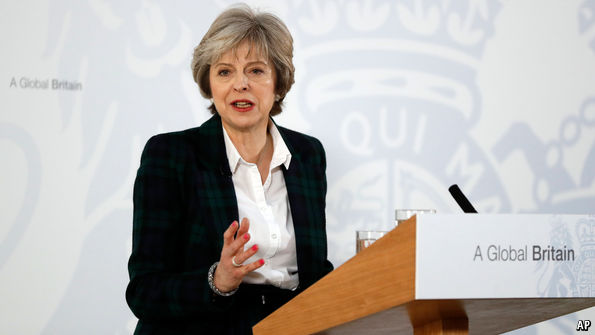
In fact the pound rose on January 17th when she gave a speech that set out her most detailed thinking so far about Brexit. That was partly because her decision to leave the single market and customs union had been widely trailed, causing the pound to fall in the run-up to her speech. But it may also have been because markets were pleasantly surprised by her language in setting out a dream of a liberal, open future for the country—she spoke behind the slogan “A Global Britain”—and her expressed wish for continuing friendly relations with Europe.


There is a liberal vision of a post-Brexit future in which Britain escapes the most protectionist features of the EU and opens its economy to the rest of the world. It is one that includes lower taxes, less pettifogging regulation and freer trade. During the referendum campaign it was sometimes talked of as “Singapore on steroids”: a dynamic, open Britain capable of competing not just with other EU countries but with the whole world.


The trouble is that, for all her pleasing rhetoric, Mrs May is not really pursuing this vision. She has set immigration control as her priority (see Bagehot), even though today’s service businesses depend on being able to move people around at short notice, as does high-tech industry. A similar drawback attaches to her insistence on escaping the jurisdiction of the European Court of Justice (ECJ). Free-trade deals require a neutral umpire. So would any effort, hinted at again by Mrs May, to secure post-Brexit barrier-free access to the EU’s single market for such key industries as cars and financial services (see article).


Such a sectoral approach is anyway unlikely to work, for two reasons. One is that the EU will not offer favoured access to its market only for certain industries. The second is that the World Trade Organisation does not allow it. The WTO accepts free-trade deals and customs unions, but only if they embrace “substantially all the trade”. Were the EU to single out cars, say, for barrier-free trade with Britain, the EU would be obliged by the WTO’s non-discrimination rules to offer the same deal to all WTO members, including China and India.


Mrs May was frank about the trade-off between being in the single market and taking back control of borders and laws. She even declared that to stay in the single market would mean “to all intents and purposes” not leaving the EU at all. But she was less honest in not admitting that Brexit will impose costs, and that a hard Brexit will make them heavier. A YouGov poll for Open Britain, a pro-EU group, finds that even a majority of Leave voters are not prepared to be made worse off in order to control immigration.


Mrs May’s response that the economy has done better since the referendum than economists forecast is disingenuous. Not only have easier monetary and fiscal policy and the fall in sterling cushioned the impact but Brexit has not yet happened—and until recently many firms hoped to stay in the single market. Nor did Mrs May offer any solution to the problems that leaving the single market and customs union will cause for the border with Ireland, where there are currently no customs checks.

Negotiating free-trade agreements will be harder and more time-consuming than Mrs May suggests. She expressed hope that a comprehensive deal with the EU could be done in two years. But experience suggests this is highly unlikely. Many EU countries say they need to settle divorce terms (dividing up property, pensions and so on) before even talking about trade. Canada’s free-trade deal with the EU has taken seven years and is not yet in force. For Britain to replicate the EU’s trade deals with 53 third countries will be more testing than today’s enthusiastic talk of an early agreement with America suggests (see next story). And ratification is always tricky: a recent ECJ ruling makes a free-trade deal with Britain a “mixed” agreement that must be approved by every parliament in the EU, including regional ones.
The truth is that when Mrs May formally triggers Brexit she will find the cards stacked against her. Subject to an imminent Supreme Court ruling on needing parliamentary approval, she plans to initiate the process in March. The divorce proceedings then have an extremely tight two-year deadline. Mrs May acknowledged the need for transition, but only as an implementation process towards a final deal. As she conceded, the other 27 EU countries have been impressively united over Brexit. They may welcome her new clarity, but for them the preservation of the union is more pressing than all else. As several leaders have said, Britain cannot have a better deal outside than inside the club.
Mrs May made helpful noises about not wishing to see the EU unravel, unlike Donald Trump. She stressed the need to retain co-operation on foreign policy and security. And she said Britain might pay modestly into the EU budget (though no longer “vast contributions”, so talk in Brussels of an initial Brexit bill of upwards of €50bn, or $53bn, may not go down well). But she also threatened her partners, calling it an act of “calamitous self-harm” if they pushed for a punitive settlement; Britain could retaliate by slashing taxes, she said. She believes her predecessor, David Cameron, made a mistake by not being ready to walk out rather than accept inadequate new membership terms. In her speech, indeed, she insisted that no deal was better than a bad deal.

As Malcolm Barr of J.P. Morgan points out, this is a dangerous line. No deal would mean falling back on WTO terms, implying not just non-tariff barriers and lost access to the single market but actual tariffs on exports of cars, pharmaceuticals, processed foods and much else. The EU would suffer too, but its goods exports to Britain are worth only 3% of its GDP; Britain’s to the EU are worth 12% of its own GDP. Mrs May has made a powerful case for her version of a hard Brexit. But it is Britain, not the 27, that is the demandeur in these negotiations. And that will make securing a good outcome hard in every sense.

www.economist.com

2016/10/03

La libra baja 0,9% tras anuncio de Theresa May sobre inicio del Brexit

No obstante, este retroceso no fue tan fuerte en comparación con el 11% de caída que sufrió la libra esterlina después de que los británicos votaron el pasado 23 de junio a favor de salir de la UE.EFE | INTERNACIONAL www.pulso.cl

© Bloomberg
La libra bajó hoy un 0,9% frente al dólar en el mercado de Londres, después de que la primera ministra británica, Theresa May, informase que activará el artículo 50 sobre la salida de su país de la UE antes de finales de marzo de 2017. 
La moneda británica retrocedía 0,9% hasta situarse en US$1,285, mientras que perdía 0,8% frente al euro hasta 1,144 euros, en tanto que en los mercados asiáticos la caída fue 0,5% frente a la divisa estadounidense, según los expertos. 
No obstante, este retroceso no fue tan fuerte en comparación con el 11% de caída que sufrió la libra esterlina después de que los británicos votaron el pasado 23 de junio a favor de salir de la UE. 

De acuerdo con los analistas, los términos de las negociaciones sobre la salida serán determinantes para saber si la moneda británica sufrirá nuevas caídas o se recuperará en los mercados. 

2016/09/22

Brexit: esperan impacto en empleo y en inversión

Votación que determinó la salida de Reino Unido de la UE podría generar una caída en el crecimiento británico.REUTERS | INTERNACIONAL www.pulso.com

La inversión británica y el empleo podrían registrar un crecimiento nulo el año próximo debido a la votación en junio a favor de salir de la Unión Europea, indicó un sondeo realizado por el Banco de Inglaterra entre empresas que predispone al organismo a recortar de nuevo las tasas de interés este año.
Los agentes regionales del Banco de Inglaterra, que hablan con empresas de todo el país, encontraron señales de resistencia en el gasto de los consumidores y el mercado de la vivienda hasta el momento. Pero también detectaron una reticencia cada vez mayor entre las empresas a contratar e invertir.
“Las intenciones de inversión y de empleo habían caído, y estuvieron en consonancia con unos niveles planos (sin crecimiento) a grandes rasgos en los gastos de capital y empleo en los próximos 6-12 meses”, dijo el Banco de Inglaterra.
El estudio mostró los planes de inversión más débiles entre las empresas británicas desde 2010.

El Banco de Inglaterra ha dicho que prevé que la tasa de crecimiento se reduzca a menos de la mitad el año que viene situándose en 0,8%. El miércoles, la OCDE redujo a la mitad su previsión para el crecimiento económico británico de Reino Unido en 2017, al 1,0%.

2016/09/13

El Brexit debería concretarse antes de 2019

Eso fue lo que dijo el negociador del Parlamento Europeo para la salida del Reino Unido de la UE. También indicó que Londres tendría que aceptar la libre circulación de personas si quiere mantener el acceso al mercado único del bloque.REUTERS | INTERNACIONAL www.pulso.cl

El negociador del Parlamento Europeo para la salida de Reino Unido de la Unión Europea dijo este martes que el Brexit se concretaría antes de 2019 y que Londres tendría que aceptar la libre circulación de personas si quiere mantener el acceso al mercado único del bloque.
"El #Brexit debería estar concretado antes de 2019, cuando las políticas de la UE entren a un nuevo ciclo y el @Europarl_EN (Parlamento Europeo) inicie un nuevo mandato", escribió Guy Verhofstadt, eurodiputado belga, en Twitter.
"Si Reino Unido quiere (mantener) el acceso al #mercadoúnico, tiene que aceptar también la libre circulación de ciudadanos. Nuestras cuatro libertades son inseparables", agregó Verhofstadt.