Mostrando las entradas con la etiqueta Apple. Mostrar todas las entradas

2018/08/08

Crossing $1 Trillion: What’s Next for Apple?

Apple valuation

MIC LISTEN TO THE PODCAST:

Former Apple CEO John Sculley and Erik Gordon from the University of Michigan discuss Apple's $1 trillion market capitalization.
Consumer electronics giant Apple is finding itself in a whole new race after last Thursday, when its share price rose to $207, making it the first U.S. company to cross $1 trillion in market capitalization.
As Apple and its CEO, Tim Cook, set their sights on the future, experts from Wharton and elsewhere point out that the company does face some challenges: Apple’s smartphone sales have slowed (although margins have gone up); it has no big-bang product around the corner, notably in augmented reality or artificial intelligence (AI); its R&D investments are lagging; and its next big leap may take place under a different CEO.
Meanwhile, other tech giants such as Amazon, Google’s parent Alphabet and Microsoft are close runners-up in the trillion-dollar race, heralding a new era of large, cash-rich companies. Platforms and ecosystems are critical to success in the next round, and some predict that Amazon looks poised to become the first $2 trillion company, especially with its ability to seemingly enter any industry it chooses to.
Credit Where It’s Due
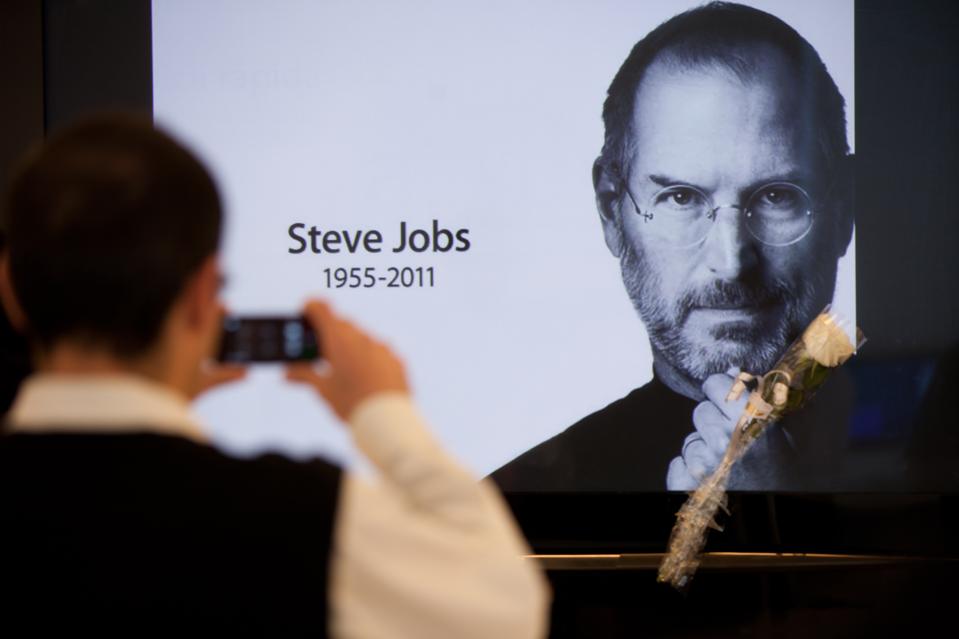
At least the first $500 billion of Apple’s market cap should be credited to the firm’s previous CEO, the late Steve Jobs, according to John Sculley, who was CEO of Apple from 1983 to 1993. During a recent interview with the Knowledge@Wharton show on SiriusXM, Sculley recalled his first meeting with Jobs at Apple in 1982: “[He] was thinking about something that nobody else in the high tech world thought was even important — he wanted to build a personal computer, because he thought the future of computing was going to be for non-technical people to be able to have something easy to use [to] do all kinds of amazing, creative things…. Those foundational principles that Steve created way back in the early 1980s are still the foundational principles that Apple sits on today.”
He then gave Cook “a lot of credit for the next $500 billion,” and explained why: “He came up with a strategy for loyalty with shareholders that is incredibly powerful, just like Steve came up with a strategy for loyalty with consumers.”
That said, “Apple doesn’t have a next act that we’re aware of after the iPhone,” said Sculley. “Steve Jobs had the brilliance to realize that you could do photography in an entirely different way with a handheld device, and that you could send photos to another device. And that led to all the things we [have today]. The question is, what comes next?”
“If we believe that design is not going to be enough, and deep tech is going to be a differentiator … Apple should speed up its investment in R&D.”–Gad Allon
According to Sculley, Cook is probably right when he said in an earnings call last year that augmented reality will be the next big area of action in consumer technology. He noted that from the standpoint of shareholder value, Apple may not need a blockbuster product anytime soon, “but it is going to need it in maybe five or seven years” — when AI, augmented reality and “other foundational things that will probably be part of what comes next after iPhone will happen….”
At present, Apple lacks “a significant depth or innovation in the areas that are going to be significant in the future,” noted Wharton professor of operations, information and decisions Gad Allon. Apple is lagging in AI and AI-based products such as Siri, and sales of its HomePod speakers are slow, he added. “If we believe home and TV are the next battle, Apple has not figured out these, and if we believe mobility — or car as a platform — is the next battle, Apple is losing there as well.”
Apple has been lagging in its R&D investments as a percentage of revenues, behind its competitors including Amazon, Google and Samsung, said Allon, who is also director of the Jerome Fisher Program in Management & Technology at the University of Pennsylvania. This is notwithstanding the fact that Apple has increased its R&D investments significantly over the last few years, he added. “If we believe that design is not going to be enough, and deep tech is going to be a differentiator in some of these key areas, Apple should speed up its investment in R&D.”
Erik Gordon, a professor at the University of Michigan’s Ross School of Business who joined Sculley on the Knowledge@Wharton radio show, agreed that augmented reality will be the arena for the future of consumer technology. “It’s going to be fabulous, and it’s going to be very cool, but I don’t think it’s in Apple’s next product cycle,” he said. “But keep in mind that Apple has good technology capabilities and they have more cash probably than the U.S. government to invest. They can keep shareholders happy over the next four or five years – they can just keep them happy with stock buybacks; they have so much cash.”
A Wartime CEO
Gordon said that he sees Apple as a contender in the markets where AI and augmented reality will reign. “Apple will be a player in the next round,” he predicted. “But it might be a new CEO because it’s not Tim Cook’s strong point.”
Tim Cook is a “peacetime CEO,” according to Allon. “He got the firm in very good shape with a deep, innovative product line, and his main role has been executing the plan. He has a great user base that is absolutely addicted to Apple’s products. Tim Cook has done pretty much what he needed to do to deliver on this.” That said, Apple’s next CEO “will have to be a wartime CEO — one that is getting a few depleted cash cows with the need to recreate the next innovation.”
“[Augmented reality is] going to be fabulous … but I don’t think it’s in Apple’s next product cycle.”–Erik Gordon
The task for Apple’s next CEO would be significant, Sculley said. “I wouldn’t want to be the next CEO coming in after Tim Cook, because the next CEO is probably going to have a very challenging strategic set of issues over the next four, five, six or seven years —  eventually this model will be a challenge because there [will need to be] innovation.”
If Apple fails to seize the moment and gain leadership in augmented reality or another new technology, some other company will, Sculley said. “As AI and machine learning become more and more integrated into everything, [the next leader] will be [a company] like Google, which has clearly invested incredible amounts [into] R&D and great talent. Will they be able to productize it better than Apple? The next CEO who follows Tim Cook is going to have to focus on those kinds of issues.”
Amazon Closing In
Gordon pointed out that Amazon has performed better than Apple on the stock markets. “Amazon actually in some ways has a better market cap growth story; its market cap now is somewhere around $890 billion, which is about 90% of Apple’s,” he said. Seven years ago, Amazon’s market capitalization was only a third the size of Apple’s market cap. The pace at which that has grown clearly makes it “the rocket ship” in market cap growth, he added. Other large technology companies are close, such as Alphabet with a market cap of nearly $870 billion, and Microsoft with $830 billion, he noted. “So we have a group of really large new-generation companies.”
Gordon did not see any natural limit to how large those companies could become. “They have their fate in their hands,” he said. “As long as they creatively reach out and do new things, I don’t know why [$1 trillion] would be a ceiling. For example, Amazon, which seems to be willing to try almost anything — how to put a cap on them?”
Amazon is Sculley’s pick for the next big winner. “Apple may be the first $1 trillion company, [but] Amazon probably is a more likely candidate to be the first $2 trillion company,” he said. “I would agree with [Gordon] that Amazon has been able to invent line of business after line of business after the line of business. I think Jeff Bezos is the most competent CEO in the world right now, and it doesn’t look like he has any intentions of slowing down.”
“Jeff Bezos is the most competent CEO in the world right now, and it doesn’t look like he has any intentions of slowing down.”–John Sculley
Apple’s Strengths
Apple put up a strong show in its latest fiscal 2018 third-quarter earnings report last week, posting a 40% growth in earnings per share and a 17% growth in revenues, year-over-year. Gordon parsed those to highlight some trends that underscore Cook’s contributions. For example, he noted that revenues have grown smartly although smartphone sales growth was almost flat in the third quarter. “Their success has been getting people to buy more expensive phones, so the average selling price has gone up,” he said. He noted that the ability to sell $1,000 phones may have seemed far-fetched five years ago.
Apple has also been vastly more profitable than others in its industry, Sculley said. “Apple only has 15% of the physical smartphone market, but it’s got about 95% of the profits in the smartphone ecosystem,” he said. “Apple is leveraging its ecosystem — a consumer experience so good between the different devices — and leveraging that service revenue.” At the same time, smartphone users have slowed down their pace of upgrading their devices, said Sculley. “We haven’t seen the replacement cycle [being] as rapid as it’s been in the past.”
According to Sculley, Cook has done “a very good job” building shareholder loyalty. “He does it because he has 10 times as much cash ($285 billion as of December 2017) as Amazon does. He’s buying back stock — about $100 billion this year. They give a big dividend. They don’t try to be the innovator of what’s coming next and take risks. They trail innovation by a couple of years. So the iPhones don’t necessarily have the latest new technology, but they do a really good job when they deploy it and they do it at scale.”
Apple has also in recent quarters increased its emphasis on services, said Gordon. Although services form a small part of its revenues and profit, they tend to have high profit margins, he noted. In recent earnings calls, the company has encouraged equity analysts to focus also on that part of its business. He pointed to one survey, which showed that 38% of a sample of 1,000 iPhone users had additional iCloud storage; about 18% stream Apple Music — about the same number of iPhone users that stream Spotify — and about 23% buy AppleCare protection plans for their devices. However, Gordon did not expect the services push to compensate for the next blockbuster product. “They will need something else to regenerate growth after they’ve bought back all the stock they want to buy back,” he said.
Allon is convinced that “Apple has been, and will be, a product firm.” He said the services are used to help and sell more products, and gain a bigger share of the wallet from existing customers. “But Apple makes money by selling better products than any other firm,” he said.
“The big question is: What’s the next category of products — Home? Car? Augmented reality? Apple is trying to play in all of these, but we have not seen a game-changing product yet….”–Gad Allon
According to Allon, Apple’s “only truly innovative product” in recent years was the Apple Watch; the HomePod was “too late to the market,” and although the iPhone is doing well, that is not where growth will come from. “The big question is: What’s the next category of products — Home? Car? Augmented reality? Apple is trying to play in all of these, but we have not seen a game-changing product yet there from Apple, and it is definitely losing ground.”
Platforms over Products
Platforms will be more important than products for the next tech leader, according to Sculley. “[It’s] being driven by all kinds of new innovations — in drones, in precision medicine and robotics. All of these are opening up huge opportunities to completely re-imagine what industries will be like. The most fundamental to all of them are the business architectural platforms. Apple obviously has an important platform, but so do a lot of other companies.” With more and more innovation occurring in the platform space, he saw “the opportunity for more Apples, more Amazons, more Microsofts over the next decade.”
Scanning the future for the smartphone market, Sculley said he expected the industry to become more and more commoditized. Chinese companies are likely to have an edge in that scenario, because of the speed at which they are able to scale production, he added. “We don’t know how to scale a business that fast in the U.S. So there are going to be different ground rules for creating these extraordinary, successful companies in the future that are different than the models that we’ve used in Silicon Valley up until now.”

2018/01/12

Are Apple, Facebook, Google and Amazon Unstoppable?

book1
41HF4gOPvxLApple, Google, Facebook and Amazon have created products and services enjoyed by billions of people. But their size and reach into our daily lives also is cause for concern. Scott Galloway, a marketing professor at New York University, shines a spotlight on the dangers of letting Big Tech invade our personal lives without a second thought in his book, The Four: The Hidden DNA of Amazon, Apple, Facebook, and Google. He recently spoke on the Knowledge@Wharton show on SiriusXM channel 111 to explain why people need to pay attention.
The following is an edited transcript of the conversation.  
Knowledge@Wharton: These four companies have come very far in a relatively short amount of time. While they have certainly reaped the benefits of the internet and gathering of data, what other common factors have propelled their growth?
Scott Galloway: Since 2008, these companies added more market capitalization than the GDP of India. The value accretion and influence is just staggering. I think each of them taps into a fairly basic instinct. Google taps into our need for a super being and some sort of divine authority to help us answer questions. We used to look to the skies and pray, ‘Will my kid be all right?’  Now we type symptoms into the Google query box. One in six questions presented to Google have never been asked before in the history of mankind, which intimates its incredible authority.
Facebook calls on our instinct to not only be loved but to love others. Using photographs catalyzes and strengthens relationships. Amazon is our consumptive gut. We have a need for more. The penalty for too little is starvation. The penalty for too much is lethargy or gluttony, which is a fraction of the downside of too little. Open your cupboards, open your closets. We have 10 to 100 times what you really need.
Finally, I think Apple calls on our reproductive instinct. The iPhone is the new way to signal that you have good genes. It says you’re part of the innovation class. It says you’re successful and a worthy mate.
Knowledge@Wharton: Apple has put together an impressive ecosystem in the last two decades. People want to be seen with an iPhone or Apple product because it is a status symbol.
Galloway: If you look at the watch industry and the apparel industry, they both incurred significant losses or a huge decline in shareholder value across many or most of them. We look at the over-storing of America. We look at retail, and there is too much competition. But I would argue that Apple is the new way we indicate or signal self-expressive benefit. It used to be through clothes and watches and shoes and jewelry, but I think Apple has taken the place of these items.
Knowledge@Wharton: Why hasn’t the Apple Watch caught on as much as the other products?
Galloway: The Apple Watch has become a second screen to what is the most important item or accessory now, and that’s the iPhone. I’m not sure the Apple Watch will be around in three to five years. But it doesn’t matter because what Apple’s been able to pull off, mostly through the iPhone but also the supporting ecosystem, is a company that has the production volumes of Toyota with the operating margins of Ferrari. Apple’s pulled off the impossible in business in that it’s a low-cost producer with a premium-priced product. As a result, Apple is going to do double the profits this quarter than Amazon has done in its entire history as a company. We’ve never had a company this profitable.
“Apple’s pulled off the impossible … it’s a low-cost producer with a premium-priced product.”
Knowledge@Wharton: Where do you see the pitfalls for Facebook? The company is dealing with the dark side of social media, including trolling, cyber-bullying and interference by Russian hackers.
Galloway: I believe the worm has turned against Big Tech. Up until just a couple months ago, we engaged in what I would refer to as a gross idolatry of innovators and youth. It really manifested around these few companies, yet they weren’t subject to the same scrutiny that the rest of business endures.

The weaponization, if you will, of Facebook and Google has really highlighted some issues around what it means to be a media company and not have the safeguards in check that some other media companies have in place. We’re asking some very difficult questions. Like any crisis, where it turns into a major crisis is when you don’t respond or address the issue. There’s been a series of half measures that have come out of Facebook. First, it was 250 employees to monitor safety, then it went to 1,000. But I don’t think they’ve really addressed the issue.
Knowledge@Wharton: Should Mark Zuckerberg have considered these potential problems when he came up with the idea of Facebook and put safeguards in place then?
Galloway: In his defense, I don’t think even he probably imagined that 60% of Americans would get their news from social media. It’s an incredible business model to have other people creating your content. It’s an incredible business model not to have the friction of human intervention around who’s advertising on your platform. It’s incredible to your profitability. But it’s the equivalent of being a member of a beach club, and the club would be more profitable if there was no lifeguard. The same thing happened here. There are no editors. There are no people screening the content or the advertisers. As a result, that injects some danger into the system.
Knowledge@Wharton: Is Amazon going to be the first company valued at $1 trillion?
Galloway: The easy guess would be Apple because they’re closest at $750 billion. But I think the good money is on Amazon. If you look at Amazon’s momentum and where it butts up and competes against the other three, they’re winning. Google controls 90-plus points of share for all of search, but Amazon now controls 55% of product search, up from 44% in 2015. The most innovative hardware product of 2015 and 2016 wasn’t the Apple watch or the Apple pods but Amazon’s Echo device. You can go through each of them, and wherever they’re butting up against each other, Amazon is winning. I don’t think we’ve ever seen a company with this much momentum or strategic advantage as we see in Amazon right now.
Knowledge@Wharton: What do you think of Amazon’s acquisition of Whole Foods?
Galloway: I would argue that Whole Foods will be to Amazon what Instagram was to Facebook. I think it’s going to be one of the best acquisitions in the history of that sector. Amazon now has permission or license to get into the wealthiest refrigerators in the nation. The only way you create intensity across those 60% of households that now have a relationship with Prime is to offer grocery. For what was a 2% or 3% dilution, Amazon now has 500 well-lit warehouses with proximity to the wealthiest households in America, access to long-tail brands. This was a genius acquisition.
Knowledge@Wharton: What is the reaction in that specific sector of the economic world? What can Walmart do to keep their share of the market?


Galloway: People tend to pit it as a win/lose between Amazon and Walmart. I think they’re both going to do pretty well in the digital age. Walmart is an incredibly well-run company, the largest grocer. They’re not befuddled prey waiting around for Amazon to disrupt them. They’re making a series of acquisitions. They’re doing some interesting things both in terms of acquiring Jet.com to be an adrenaline shot to their heart around e-commerce [as well as] their acquisition of Bonobos. Their click and collect [strategy], trying to take advantage of their stores. As we’ve seen, the stocks actually perform pretty well. I don’t think it’s an either/or. Who will be successful? Amazon or Walmart? I think the answer is, yes.
“I believe the worm has turned against Big Tech.”

Knowledge@Wharton: For Google, where is that next mountain to climb?
Galloway: The next battleground across most of them is in the home. To capture more of people’s attention, the home seems to be the next frontier. There’s been this enormous battle waged over the screen in terms of the phone. Netflix, Amazon and Apple are now waging that battle on the second most important screen: your television. But the notion of being relationship vis-à-vis voice in the home, that seems like the next battleground. Google is playing catch-up, and Apple kind of gave up the early lead to Amazon. But I think the next big battlefront is voice and artificial intelligence, and the battlefield is going to be the home.
Knowledge@Wharton: I grew up going to the movie theater and the grocery store. What will happen to these types of outlets in the future? Which has the greatest concern?
Galloway: All of them. Not only that, the disruption happened before. In between the time that Amazon announced the acquisition of Whole Foods and when it closed, the largest pure play grocer in America — Kroger — lost a third of its value. Keep in mind Whole Foods is only one-eleventh the size of Kroger. If you didn’t know Amazon had acquired Whole Foods, you wouldn’t know. It wasn’t as if Kroger’s business changed overnight, but it’s the expectation that Amazon is going to destroy industry after industry. It’s happening in movie theaters. AMC stock is off hugely. It’s not what industry will Amazon disrupt, it’s more difficult to think about what industries in the consumer world it won’t disrupt.
Knowledge@Wharton: It seems that even a Goliath like Comcast could be a takeover target of one of these four companies.
Galloway: I don’t think anybody’s safe. If you look at these companies, they’re now in sort of a defensive posture. They have incredible assets. They have cash flow. But television was supposed to be a place that was somewhat immune from these players. Now all of these players are doing things like bidding on sports. It’s only a matter of time before the rights of the Super Bowl are purchased by one of the four.
Knowledge@Wharton: Are there companies on the fringe of those four that could become part of the group in the next five to 10 years? Will we have five or six tech companies running everything?
Galloway: I have a chapter called “Who Is the Fifth Horseman?” I try and go through the features or components of being a $500 [billion] or $700 [billion] market cap company, and then apply that same criteria to try to identify who might be next. There probably is a fifth horseman right now, and that’s Microsoft. But I didn’t write about Microsoft because I think of it as a B2B company.
In terms of the new guys, the one that is probably in striking distance right now is Netflix. At the end of the day, these companies are all operating systems for media, for information, for retail. Netflix is becoming an operating system for the second-most important screen in our lives, and that’s the television. Millennials spend more time watching Netflix than the rest of cable television combined. So, Netflix is on the verge of being in the same weight class. People talk about Amazon versus Walmart being a huge battle. I think the battle that’s really shaping up to be the celebrity death match of the next decade is Amazon and Netflix.
“I would argue that Whole Foods will be to Amazon what Instagram was to Facebook.”
Knowledge@Wharton: What about the future of movie theaters?
Galloway: I think it’ll be similar to the magazine and newspaper industry in that movie theaters aren’t going to go away, it’s just going to be a difficult place to work or invest. We knew Blockbuster was going out of business, but we thought it was going out of business in 1998, and it took another 14 years. People are still going to go to the movie theater, but your home viewing experience is getting better and better. The original content available in your home is getting better and better. Film will continue to leak consumers’ revenues and talent and capital to television in the home.
Knowledge@Wharton: Do you have concerns about these companies having so much influence over almost everything that we do?
Galloway: Very much so. I believe we engage as a society in what I would refer to as the gross idolatry of youth and innovators. These companies are not subject to the same scrutiny as the rest of business. If the terrorists in San Bernardino, California, had been using a Blackberry, and Blackberry [formerly known as RIM] out of Canada had refused a court order from the FBI to let the FBI get into the phone to see if other terrorist activities were unfolding, I believe we would have had a trade embargo proposed against Canada within 48 hours.
But we’ve decided that the iPhone is the new object of worship. They shouldn’t call it the iPhone X, they should call it the iPhone Cross. We let these companies engage in massive tax avoidance. We don’t hold them responsible as media companies the same way we hold other media companies responsible. I think these companies get the mother of all hall passes. They’re just not subject to the same standard and the scrutiny as the rest of business.

2017/08/09

Can Apple Get a Bigger Bite of India’s Smartphone Market?

iphoneSEDuring Indian Prime Minister Narendra Modi’s meeting with American business leaders during his recent visit to the U.S., Apple CEO Tim Cook is reported to have spoken with him about Apple’s first assembled-in-India iPhone – the iPhone SE. Apple started assembling the iPhone SE in Bangalore in May through its partner, the Taiwanese contract manufacturer Wistron Corporation. Over time, this is expected to be scaled up to full manufacturing. (iPhone SE was launched globally in April last year and at a starting price of $399 was positioned as Apple’s cheapest iPhone.) While at present the Cupertino, Calif.-based technology firm sells its iPhones in India through multiple channels like franchisee-run exclusive brand stores, multi-branded stores and online, it is now waiting for approval from the Modi government to set up its own company-owned stores in the country.
Apple is also in talks with the government on various issues like duty waivers on imports of components and permission to bring refurbished iPhones to India. In the company’s earnings call in May, Cook noted that Apple was “underpenetrated” in India and was “putting a lot of energy” here. He said: “We are very optimistic about our future in this remarkable country with its very large, young and tech-savvy population, fast growing economy and improving 4G network infrastructure.”
It’s not hard to understand why India is important for Apple. Last April while announcing its quarterly results, Apple reported, for the first time ever, that sales of iPhones had dropped. The company sold 16% fewer iPhones in January to March 2016 than it had during the same period in 2015. This year, for the first three months of 2017, iPhone sales remained flat. The company sold 50.76 million iPhones, 1% less compared to the same period last year. The drop in China, Apple’s second largest market which accounts for 25% of its profits, was steep: 20%, according to industry estimates.
Ravi Bapna, professor of business analytics and business information at the Carlson School of Management, University of Minnesota, notes: “Assembling iPhones in India is a strategic diversification move by Apple to simultaneously hedge against its manufacturing reliance on China and more easily — with potentially lower costs from ‘make in India’ benefits — tap into the growing upper middle class market in India.”
India is the world’s second largest mobile phone market after China, the third largest smartphone market after China and the U.S. and, most importantly, the fastest growing smartphone market globally among the big markets. According to technology market research firm Counterpoint Research, smartphone shipments in India grew 18% annually in calendar 2016 compared to the global smartphone market which grew at 3%. In the first quarter of 2017, while globally smartphones grew by 10% year-on-year, in India the growth was 15% reaching 29 million units.
“The rollout of 3G/4G mobile broadband networks and digitalization of almost every use-case has been spurring the demand for 3G/4G capable smartphones in India. Smartphone penetration here, which is among the lowest in the world, is on the verge of a massive growth as more and more people adopt smartphones to connect to the internet for rich multimedia communication, content and commerce,” says Neil Shah, research director, devices & ecosystems at Counterpoint Research. The government’s sharp push towards digital payments is also giving it a huge boost.
Anshul Gupta, research director at research and advisory firm Gartner, points out that with slowdown in sales in major markets, India represents the largest opportunity for handset makers. According to Gartner’s data, smartphones (which currently account for around 50%) are expected to account for 62% of all mobile phones sales in India in 2018. “And, while at present the average selling price of smartphones in India is around $100, two or three years down the line, the pyramid at the top will be big,” he adds
“Apple is taking steps toward saving on import duties and pricing its iPhones cheaper than before and thereby reducing barriers to enter the Apple ecosystem.”–Neil Shah
Benefits of Local Manufacturing
Apple needs to quickly strengthen its India story to make the most of this opportunity. According to Counterpoint’s data, for the January to March quarter this year, the premium smartphone segment in India — phones priced at more than Rs.30,000 ($465) — grew at 35% year-on-year. Apple garnered a 43% market share in this category; up 10% from the same period last year. In the overall smartphone market it has only a 2.6% share (up 0.1% from last year). In terms of India’s smartphone revenue share, Apple is in fifth position with 8.6%. In the first quarter of 2016, it had 10.1% share and ranked second.
Counterpoint’s Shah sees Apple’s new assembling activities in India as a measure towards “building its foundation” in the country. “Apple,” he says, “is taking steps toward saving on import duties and pricing its iPhones cheaper than before and thereby reducing barriers to enter the Apple ecosystem.” According to industry estimates, local assembling and manufacturing can give savings of around 12%. Pointing out that at present India is one of the costliest markets in which to buy a new iPhone and that less than 3% of the total smartphones sold here are in the $600 and above range where most of Apple’s models are positioned, Shah says: “India has never been a priority market for Apple until now when it is seeing that in the next two to three years, the Indian smartphone user base will swell to almost half a billion users and many of them will be buying their second or third smartphone.”
Market intelligence firm International Data Corporation (IDC) estimates that by the end of this year, India will have the second-largest smartphone installed base (smartphones in use) with 334 million smartphones. “This huge smartphone base coupled with the fact that India continues to be largest feature phone market in the world provides tremendous opportunity for phone makers to woo users who are looking to replace their smartphones as well as those migrating from feature phones to smartphones,” says Navkendar Singh, senior research manager at IDC India.
Singh considers Apple’s move to assemble its phones in India as “critical” in terms of the cost savings it will give the company. “This can be used to bring down prices as well as for expanding distribution, channel margins, retail marketing spends and to ensure placement in smaller towns and cities, where the consumer is highly aspirational and strives for a premium brand like Apple.”
Singh also points out that with around 40 local and foreign brands including Samsung, Oppo, Vivo, Xiaomi, Gionee, Micromax, Intex and Lava already assembling and manufacturing in India, the country is fast emerging as the new manufacturing hub for mobile phones and components. He cites “relatively lower labor costs, government push and incentives for local manufacturing coupled with high differential duties on import” as some key reasons for this. “Approximately 65% of phones sold in India are assembled in India. And in the next few years, vendors are expected to start exporting devices to South East Asia and African countries from their India manufacturing operations,” he adds.
Dinkar Ayilavarapu, partner at management consulting firm Bain & Company, gives another perspective. “I wouldn’t undermine what Apple has achieved in India. What is undeniable is that they are a large player in India despite a small volume share. And that could change with domestic manufacturing. Apple, he adds, will “always be a premium priced, premium segment” operator. “I don’t think manufacturing in India is going to change that. For now, manufacturing in India is for iPhone SE, which will be the bulk of what they sell in the country but it will still be premium-priced relative to most other phones in India. Also, most large manufacturers do end up making phones in India, so in many ways this is expected as you scale up.”
“India provides tremendous opportunity for phone makers to woo users who are looking to replace their smartphones as well as those migrating from feature phones to smartphones.”–Navkendar Singh
Chinese Brands at Play
How big a bite Apple manages to get of India’s growing smartphone market remains to be seen. For now, it’s Chinese brands like Xiaomi, Vivo, Oppo, Gionee, Lenovo, Motorola and others who are having an Indian feast. A recent article in business daily Business Standard reports that according Germany-based research company GfK’s global handset update for March 2017, India accounts for 67% of Xiaomi’s sales outside China, while for Vivo it is as high as 73% and for Oppo 48%. For Gionee, 25% of total sales (including China) is from India.
As per IDC numbers, in the first quarter of 2017 China-based vendors captured 51.4% of the smartphone shipments in India with 16.9% sequential growth and 142.6% growth over the same period last year. In contrast, share of homegrown vendors like Micromax, Intex, Karbonn and others dropped to 13.5% in Q12017 from 40.5% in Q12016. Also, for the first time, in Q12017, a smartphone model from a China-based vendor became the highest shipped smartphone as Redmi Note 4 from Xiaomi replaced Korean firm Samsung’s Galaxy J2 which was the top model in Q42016. The Business Standard article quotes a Xiaomi spokesperson as saying: “India is the most important and largest market for us outside China. Our chairman has announced that we would like to invest $500 million in India over the next three to five years in manufacturing, R&D and aftersales, after having invested the same amount till now in the existing business.”
IDC’s Singh attributes this sharp growth of Chinese brands to strong investments in brand building, huge marketing spends and continuing deepening of the distribution networks in the India market. This, he says, is creating “pull and push” for these brands in both offline and online channels. “They have successfully established themselves as a real option for smartphone consumers who are looking for a great quality device, with latest specs and technology, but don’t mind spending a little extra if the whole package is offered as a great value.” Adds Carlson’s Bapna: “In many sectors Chinese companies are out-innovating, by order of magnitude, their global counterparts. One only needs to visit innovation hubs such as Shenzen to see what companies such as Huawei and Tencent are bringing to the table. The Indian consumers have a sharp sense of value, and they see this in the Chinese smartphones.”
Counterpoint’s Shah divides the success of Chinese companies in India into two phases. Phase one, he says was around online distribution while phase two is around offline distribution. He explains: In 2013-2014, Chinese brands such as Motorola and Lenovo entered India with a go-to-market strategy drawing from the e-commerce-only smartphone brand Xiaomi’s success in China. They partnered exclusively with India’s biggest online retailer Flipkart with a direct go-to-consumer model allowing them to distribute smartphones at aggressive price points with no investment needed in multi-layer distribution or marketing. Following Lenovo and Motorola, most of the Chinese brands such as Xiaomi, LeEco, Coolpad, Meizu and others entered India through the e-commerce route. “It has been an easy entry strategy without needing much investment. These companies have been able to offer aggressive price points because of their greater scale in China or other markets which Indian brands didn’t enjoy,” says Shah.
Since the second half of 2016, he continues, there has been an “onslaught” from Chinese brands such as Oppo and Vivo on the offline distribution market on various fronts. For instance, in terms of promotions — Vivo retained its sponsorship for the Indian Premier League, the hugely popular cricket tournament, paying around $340 million for five years; pricing — cheaper than market leader Samsung; place — tier 1 to tier 4 markets; and product — excellent quality thanks to their own R&D and manufacturing. “In just a span of six to eight months, both Oppo and Vivo (both owned by BBK Electronics) have jumped to the top five rankings in terms of market share in the Indian smartphone market.”
Ayilavarapu of Bain thinks the Chinese stronghold could be a passing phase. Pointing out that the largest player in volume and value is still Samsung, a Korean company, he says: “Yes, the Chinese do have a strong share in smartphones but these things change and do so quite quickly. Market share is an outcome in many ways of a product pipeline, so this is a reflection of how the players thought of products a couple of years ago. At its core this is a reflection of product and technology change, and it happens quite often. As new disruption or newer products emerge, it won’t be surprising if others take share.”
“Most players are competing on price-to-feature comparisons. They need to build key differentiators.”–Anshul Gupta
Can India Firms Fight Back?
Why did Indian players lose out in the first place? Rajeev Jain, chief financial officer of Intex Technologies, which according to IDC was at third position with a 9.2% market share in Q12016 but today doesn’t rank among the top five smartphone players in the country, points to two key factors. One, Indian firms were simply not ready for the sudden shift from 2G to 4G that happened when telecom operator Reliance Jio Infocomm disrupted the market last year with its aggressive 4G services. Unlike the Chinese vendors who had 4G products, Indian players had large inventories of 2G and 3G handsets. Two, for Indian firms, the major growth was in rural areas. Most transactions here happen in cash. This got severely impacted during the demonetization exercise last year when the government in a sudden move derecognized the existing Rs.500 ($7.40) and Rs.1,000 currency notes as legal currency. “Even as we were grappling with these two major developments, the Chinese took over the market,” says Jain.
There were other reasons, too. For instance, Indian firms missed out on the pulse of the market, like the craze for selfies and the huge attraction of front-facing cameras. They continued to focus on low-cost entry level phones even as the consumers were willing to pay more for better products with innovative features. They also did not invest in strengthening their retailing network and marketing.
“Indians love brands. Unfortunately many Indian firms have focused on making their brands discount. On the other hand, Chinese companies have focused on making their brands count,” says Jagdeep Kapoor, chairman and managing director of brand marketing consultancy firm Samsika Marketing Consultants. Gartner’s Gupta adds: “They did not build on their strengths and did not develop their portfolios adequately. Most importantly, they did not come up with any innovations.”
Bapna reiterates there is a “larger systemic issue” around technology innovation ecosystems. “When you get a cluster of companies such as Huawei and Tencent in a single region such as Shenzen, you get significant knowledge and human capital spillovers. Also, Chinese universities are ramping up their research capabilities, paying premium dollars for top American academic talent in areas such as machine learning and AI (artificial intelligence) — and that forms the backbone of the next-gen digital business models. There is no such parallel in India, and universities in India are not embedded in collaborative research and innovation with industry,” he notes. Intex’s Jain laments that there are no incentives for R&D in India. “‘Make in India’ is only a jargon. We have to convert it into reality,” he says. Jain is confident, though, that they can make a comeback. Intex, he says, will soon be introducing 25 new models, 16 in smartphones and nine in feature phones.
IDC’s Singh suggests that to get back into the game, Indian firms need to play on their strengths in the sales and distribution networks they had. “These vendors have immense opportunity in quality smartphones at below US$100 which is losing steam since they lost the plot to higher priced offerings by China-based vendors. They should also focus on giving better device experience in terms of OS functionality, camera and battery in this affordable price segment.” Gartner’s Gupta says the main challenge for Indian vendors is to come up with quality smartphones in the $100 to $200 price range with 4G connectivity and the latest processor. “Most players are competing on price-to-feature comparisons. They need to build key differentiators.”
On July 21, in a move that could well disrupt the market at the lower end, Reliance Jio announced a made-in-India 4G phone named JioPhone for as low as Rs.1,500 ($23). This amount will be fully refundable after three years making the phone virtually free for the buyers. The JioPhone comes with unlimited data at Rs.153 ($2.37) a month, free voice calls and free SMS and other features. The pre-bookings for this phone will begin on August 24 and it will be available from September.
Meanwhile, Finnish brand Nokia, which was once the smartphone leader is trying to make a comeback after a long hiatus. In a recent interview with business daily Economic Times, Arto Nummela, CEO of HMD Global, the Finnish company that manufactures and markets Nokia handsets, said: “We are driving the India portfolio first because of the love for the brand in India…. We believe that India will be the biggest market for us in the initial phase.”
“‘Make in India’ is only a jargon. We have to convert it into reality.”–Rajeev Jain
Not everyone is convinced though. Samsika’s Kapoor says: “While Nokia is a familiar name for Indian consumers, its perceived value has gone down. It will have to reinvent itself.” IDC’s Singh feels Nokia’s brand image should be able to give it “initial traction in the market, which needs to be sustained by product portfolio, marketing and distribution investments and a well thought out channel strategy.” Bapna thinks it is going be an uphill battle for Nokia. He points out that Nokia “did not readily transform from a product to a platform-based business model, and the switching costs and network effects are against it. There is a war for app developers, and platform markets are known to be winner-take-all. Customer- and app developer-centric innovations that are part of a strong platform strategy are the key to success in this market.”
Ayilavarapu notes that what worked for Nokia when they were earlier in India was a “large distribution and service network and a high quality team which allowed for exceptional on-ground execution.” But distribution, he says, is not as much of a barrier to entry any more with the emergence of ecommerce. A new player could scale up very quickly if they have the right set of products to offer. “Ultimately, this is the technology space, where changes happen often and players emerge and disappear, on account of these shifts. So the question is: What is the shift which they see, that they will benefit from?”
Gupta, however, believes that a strong physical retail presence is critical to survive in India, for not just Nokia but every player. He points out that while online sales are growing and account for around 20% to 25% of all smartphone sales in India at present, vendors whose products are easily available offline will have an edge. Nokia at its peak, he recalls, had 100,000 retailers selling its product. It’s the same with Samsung now, and Oppo and Vivo are also strengthening their offline presence.
Another key aspect, Gupta says, is customization; devices need to be tailored for the India market and connect with the local buyers. This could be through specific features, local content or even through marketing and promotions. Citing the example of Oppo and Vivo who positioned themselves as selfie experts and targeted the social network savvy younger demographic, Gupta says that many times vendors bring globally launched products, but the trick is to create a niche for your products and connect with the target segment. “At the end of the day, vendors who can develop a strategy of differentiation in terms of experience and ecosystem around services and products will have an edge.”